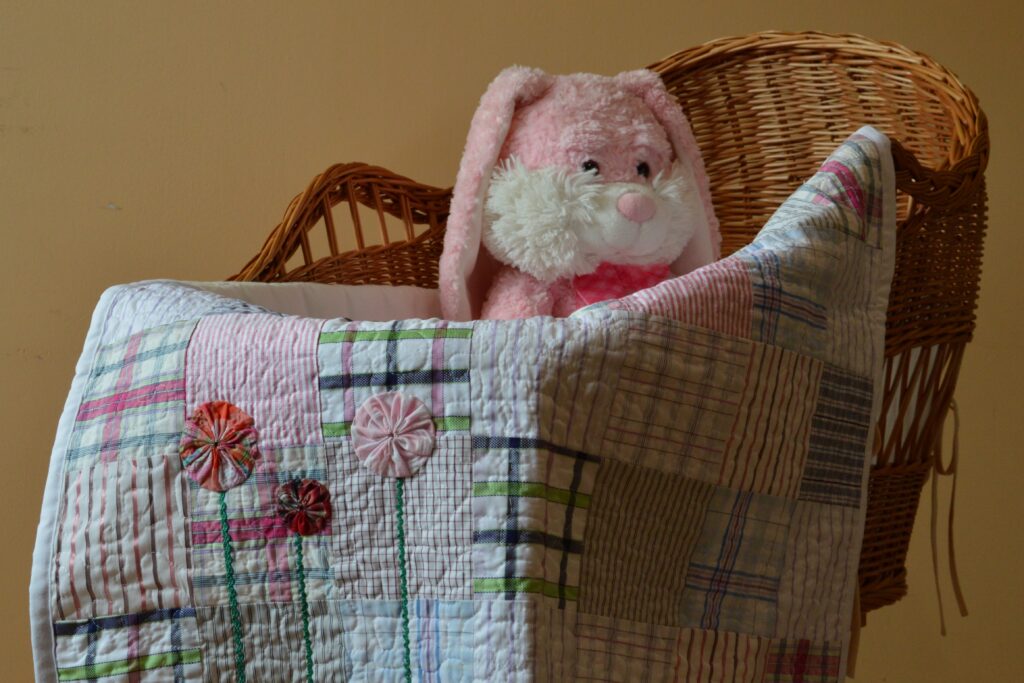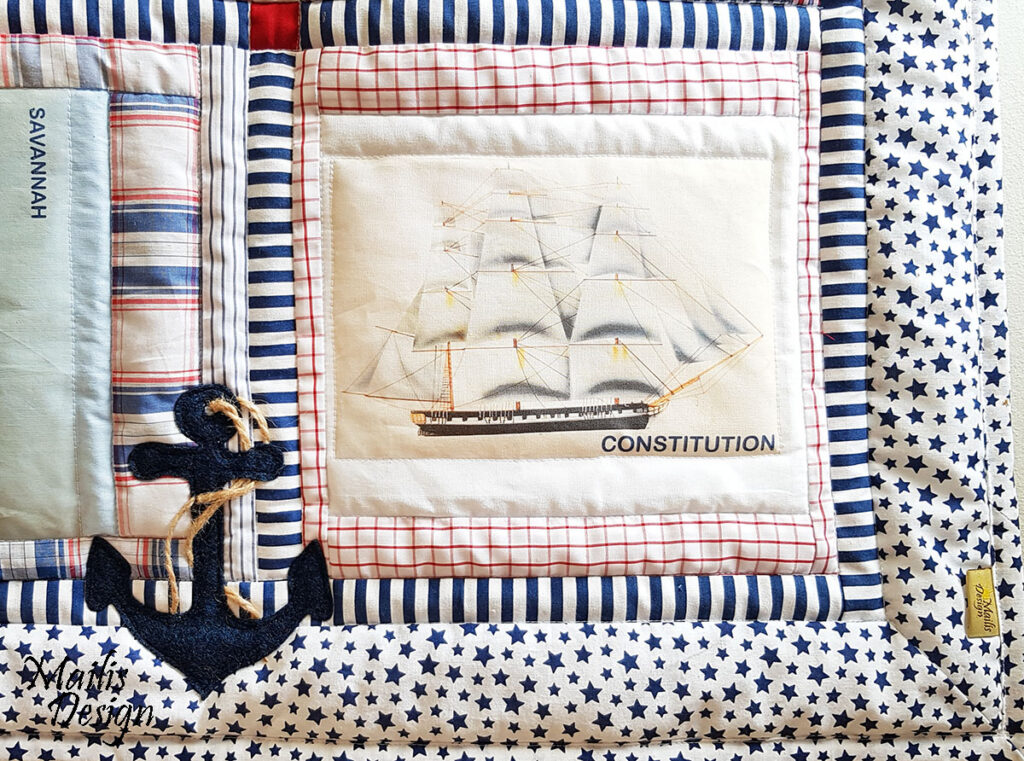
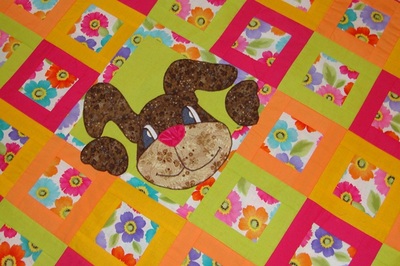
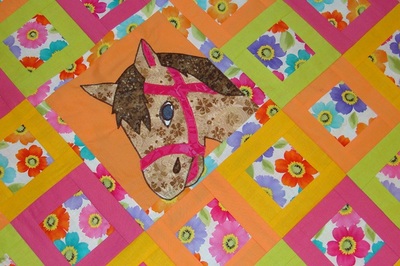
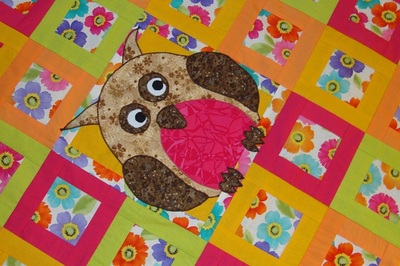
The hint pictures for the second sewing job are the 4 pictures below.
I am now trying to find a beautiful and fitting shared name for the designs of this work. Who can help?
For commissions I name the design after the child I am sewing the quilt for. Series sewn for sale have so far been named, for instance, "The quilt series 7 suns" and, under the same name, "the children's room wall hanging series 7 suns".
Now I continue the post about the hints.
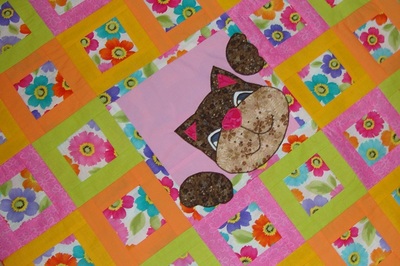
The series of quilts being made has been named "Dream animals". The dream animals here are a cat, a dog, a horse and an owl. All four quilts are meant above all for girls, as the colour range includes pink. Dream animal quilts for boys are planned for later.
About quilting a patchwork quilt.
Clients often have questions about the sewing of a quilt that are hard to explain in words alone. This time I took pictures with the aim of explaining what quilting involves.
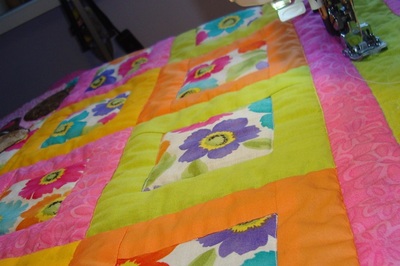
I quilt my quilts in two ways: straight quilting and free motion quilting.
The purpose of straight quilting is to fix the different layers of the quilt to one another: the patterned top, the wadding and the backing. I have the habit of quilting right through the whole quilt, both the frames of the design and the whole design as squares. The squares are where the pattern blocks join. The pattern blocks on my quilts are usually squares of 12 x 12 cm to 15 x 15 cm, and the repetition of those forms the pattern.
Here are two photographs. In the first picture the straight quilting has not been done yet and the patterned fabric ripples as it pleases. In the second picture the straight quilting is done, at the joins of the pattern blocks and over the seams of the inner flowered squares as well. The quilt is nicely in shape and will look just as good after plenty of use and washing.
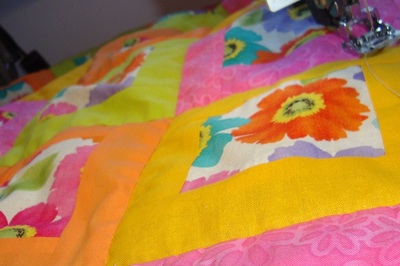
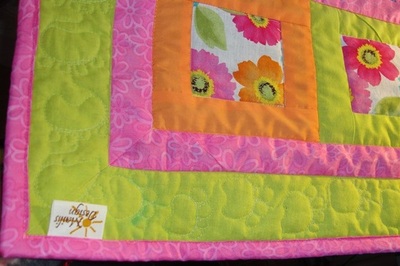
Free motion quilting is decorative quilting. To sew free motion quilting I put a small round transparent foot on the machine and guide the quilt under the needle myself, so that the seam forms the picture or pattern I want. I like to use free motion patterns at the edges of my quilts, that is on the roughly 15 cm wide frame that surrounds the design of the quilt. On this quilt I decided to draw the dream cat's footprints along the edge with free motion quilting. Each print is a slightly different size and shape from the last. But that is probably how it should be. The dream cat is dreamy and floating and unreal. 🙂
This time I also tried so called dense quilting on the background of the cat picture. That is a meandering pattern made with a single line, which must not break or cross what came before. I must admit it worked at the first attempt. 🙂
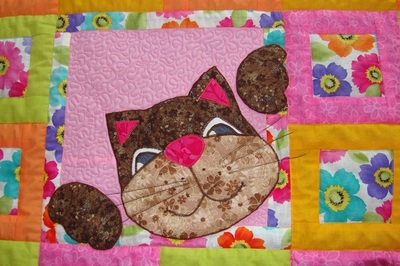
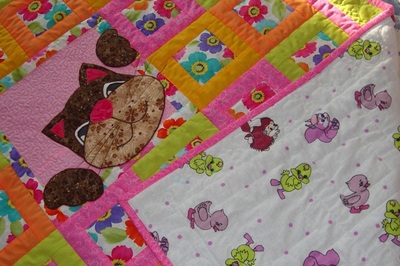
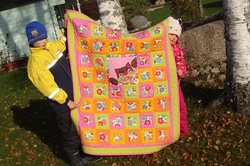
The dream cat quilt, a quilt for girls from the Dream animals series (105 x 130 cm), is finished.
The dream cat makes sure the child has beautiful dreams. Anything bad or frightening it catches or chases away. The cat watches carefully over the child's sleep all night. The proof of that is the dream cat's footprints along the edges of the quilt. As befits a fairy creature, the prints are a little confused: uneven in size, a little furtive, sometimes hurried.
The materials used are cotton fabrics.
The interlining is half wool wadding, the backing pre washed flannel. Plenty of quilting.
The other dream animal quilts go under the machine during November.