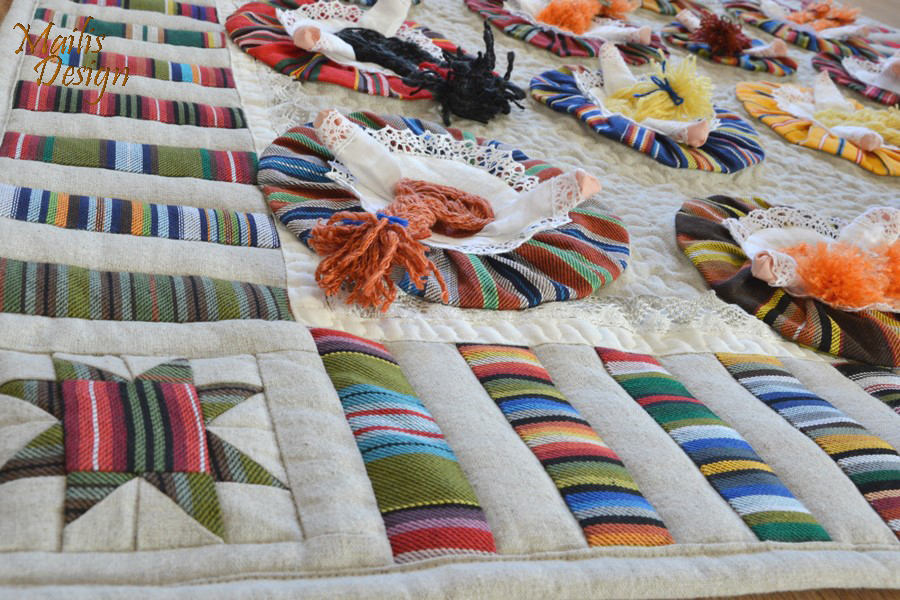
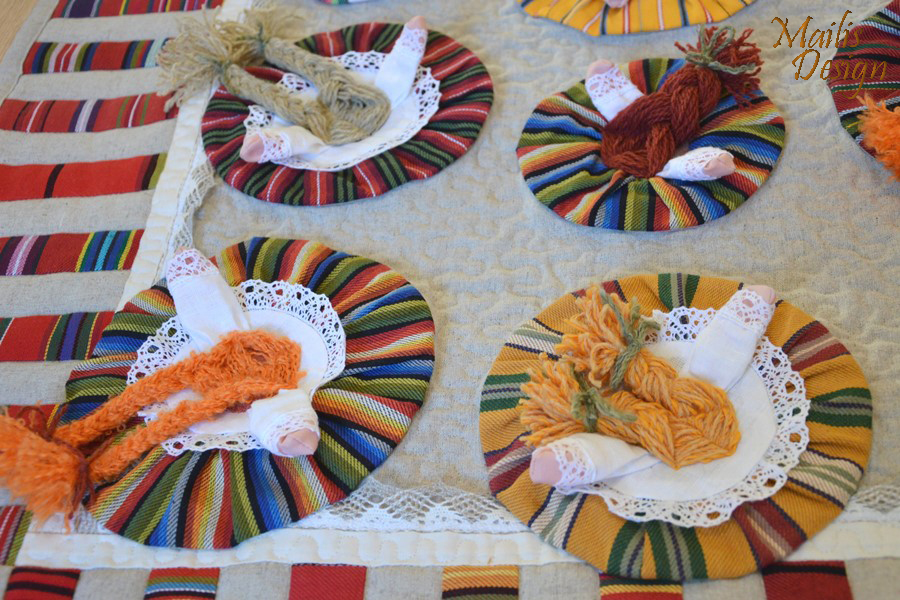
The Patchwork Quilt 100 project's panel DANCE FESTIVAL, with girls whirling in folk dance, is almost finished.
In a frame of 52 different striped fabrics, 16 girls whirling in folk dance, small and large, their plaits flying in the wind.
I have never made anything so labour intensive and yet so small.
A few hours of handwork are still left to arrange the dancers' hairstyles and to sew the fastenings and the pocket for the information text onto the back of the panel.
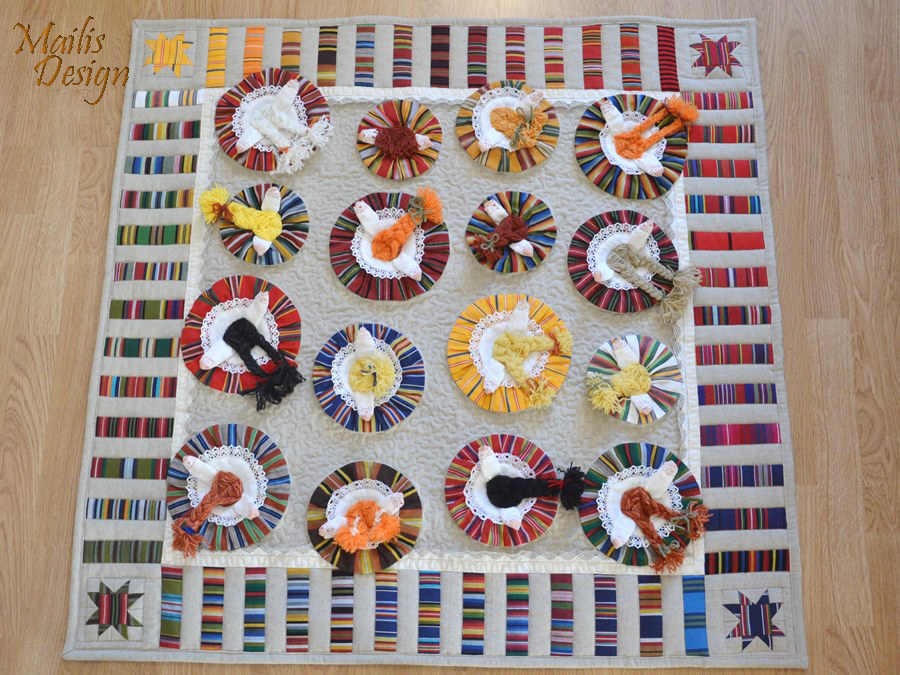
Cutting it to size was the final challenge. In sewing a quilt, accuracy to 1 cm does not matter. I always allow about 10 cm to spare, and after quilting the surfaces the quilt is almost the planned size or a touch larger.
The surface of this piece was 105x105 cm before quilting. After quilting it happened that the middle part came out wider than the edges. It actually bowed out at the sides. Happily, sewing the girls' hair and plaiting their braids got rid of that anomaly. The panel ended up fairly even. Before binding it I cut only 1 cm off all the way round.
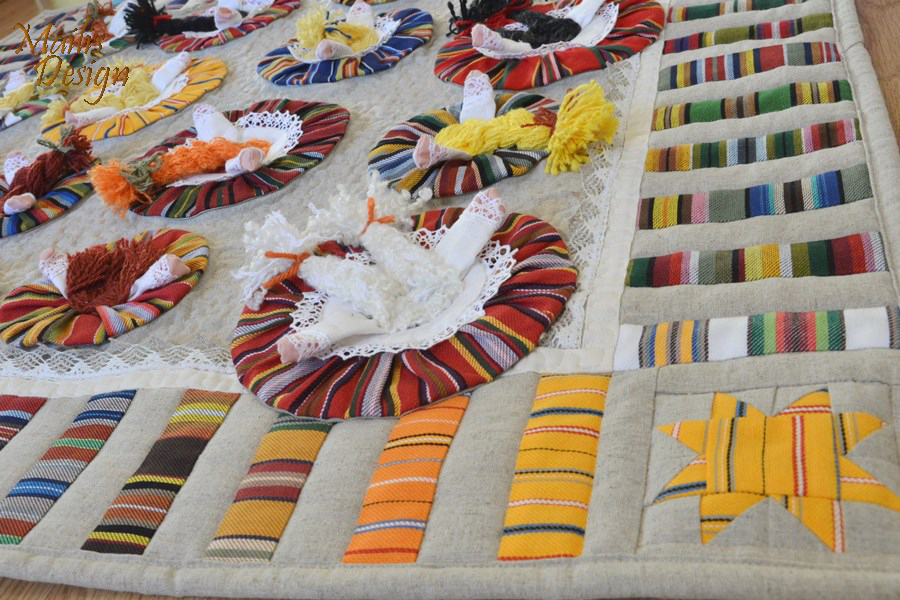
I had never made an eight pointed star before, but everything happens for the first time some day 🙂
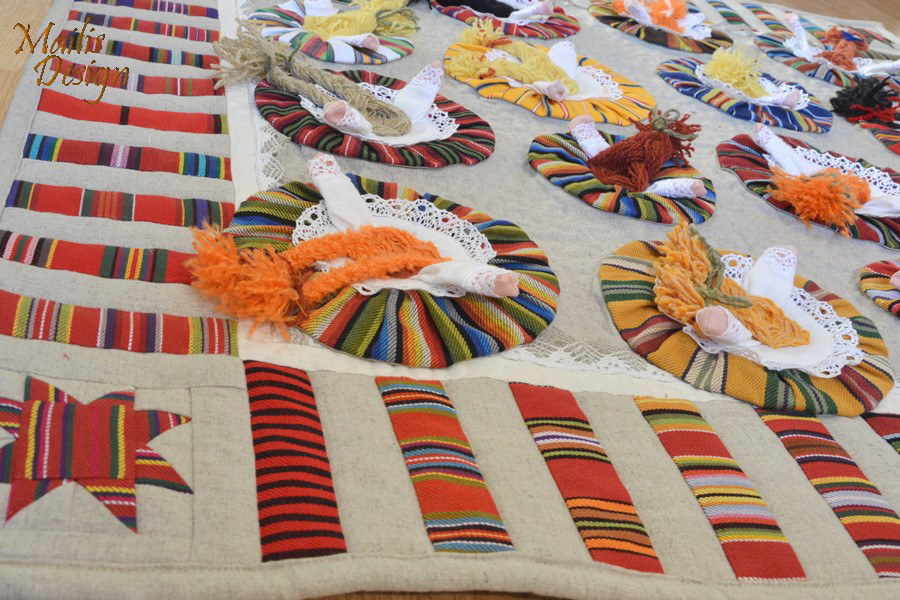
I laid the striped fabrics out in a row by colour.
From the top left it began with a yellow eight pointed star and stripes in yellow and orange tones. Then came a red corner and red and pink fabrics. Red is the most common colour in the stripes.
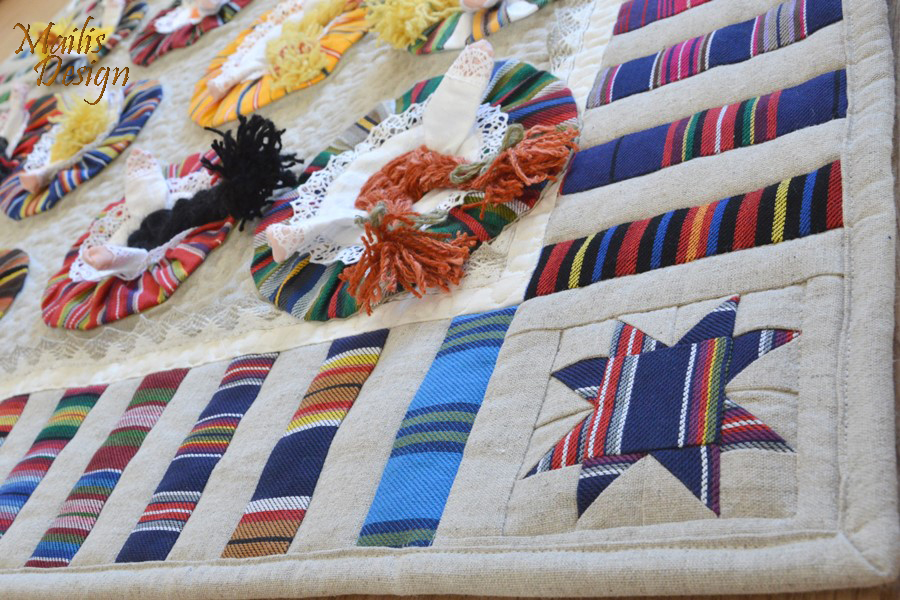
The third corner blue, and from there the colours flow to the fourth and green corner and round again to yellow. Fifty two different stripes in all.
THE TEXT ABOUT MY WORK FOR THE PROJECT BOOK:
DANCE FESTIVAL
Besides their striking ingenuity and business sense, Estonians are known as a nation of song and dance. The tradition of song and dance festivals here has no equal anywhere in the world. Thanks to it, national dress is still popular here and we have choral singing of a high standard and a heritage of folk dance.
Most recently I took part in a choral festival in Italy, where I discovered to my astonishment what a gap is left in a nation by the absence of a choral tradition, that is of motivation. If there is no choral singing, there are no suitable part songs for choirs to perform either.
We have song choirs and folk dance groups from the first years of school onwards in every school and village society. You could go on talking about that for ever.
My panel is inspired as a bow to the tradition of our song and dance festivals, to national dress, to all those capable choir and dance leaders and composers who keep it all alive and at a high standard for the whole nation and the world.
The panel is sewn from linen fabric. In the pattern I used cotton striped fabrics, 52 different ones. In the corners are eight pointed stars, symbols of joy and good fortune.
The striped fabrics, starting from the yellow at the top and going clockwise:
1. Muhu yellow, Muhu orange, Luganuse, Vaike-Maarja brown, Urvaste, Poltsamaa, Marjamaa, Karksi (2), Maarja-Magdaleena, Jarva-Madise, Kambja, Parnu, Kihelkonna; 2. Helme, Viljandi, Hanila, Rapina, Puhalepa, Noarootsi, Ambla, Kihnu, Hargla, Hageri red, Keila, Rapla blue, Jaani; 3. Haljala, Turi, Rapla blue (2), Kopu, Aksi, Peetri (2), Viru-Nigula, Karja, Ilumae, Johvi, Urvaste (2), Vonnu; 4. Marjamaa green, Poide, Juri green, Risti, Noo, Hageri green, Reigi, Pilistvere, Iisaku, Koeru, Laane-Nigula, Kadrina, Viru-Jaagupi.
Mailis Kess