If it happens that one day your hen or cockerel falls ill and you live on the edge of the capital, then forget any chance of getting help from the vets there.
If you turn to them with a sick bird (just in case, do not say at once that it is a hen), then:
* you get a quick answer that they do not deal with birds;
* your bird is admitted, but on seeing it you get a startled question: what kind of bird is that?
* they try to offer you the best help they can (consulting by telephone with a specialist who has dealt with hens), yet they still do not reach a correct diagnosis or a treatment. Never mind that the medicines on sale are products made for tropical birds, because those for poultry are produced only in so called industrial quantities (for large farms).
What happened was that one fine summer some of my birds started going weak in the legs, four birds within a couple of weeks and a fifth a month later. In the morning their legs would be shaky under them and within a couple of days they went completely.
For a month I went round various vets, read through all the literature available on poultry, offered them every possible best vitamin rich food, added tri-vitamin and a little selenium to the drinking water and disinfected the whole bird keeping setup every week (with an antibacterial powder made on a natural basis from the Kiti feed shop), but got no clear answer.
One vet recommended having one bird emergency slaughtered and taken to the laboratory on Kiili street in Tallinn. I paid 45 euros but got no concrete answer. The guess remained that it might be bronchitis, although the characteristic signs of that illness were entirely absent.
When I asked for advice on a poultry forum I was mostly told off for feeding my birds so naturally and not using shop bought complete feed. But the vet I finally found in Keila, who did know how to give me good advice, confirmed that the way I keep and feed my birds is exemplary in every respect. Poor feed affects laying above all; it does not paralyse the legs. As for selenium deficiency, she said that if there is selenium in the feed there is no need to give more on top.
Since the case looked very much like a deficiency of B group vitamins in the body, and the first laboratory answer raised the suspicion of bronchitis, on the vet's advice I gave the sick birds a course of vitamins and antibiotics. Sadly that was no help at all.
Then, on her suggestion, I had the last sick bird emergency slaughtered as well and took it to the state laboratory (the Tallinn Veterinary and Food Laboratory). Beforehand I sent an enquiry by email about what and how, and got this answer:
The VFL offers the following tests (in Tallinn and in Tartu):
1. Testing a feed sample for B vitamin content (95 euros, 2 to 4 days). Carried out by the chemistry department
2. Testing a faeces sample for parasite eggs (flotation method, 5.50 euros, 1 day). Carried out by the bacteriology and pathology department
3. Testing for bacterial disease agents from the organs of a dead hen* (aerobic testing of pathological material 16.00 euros, 4 to 6 days, and determining the sensitivity of the isolated agent to medicines on 4 discs, 8.20 euros). Carried out by the bacteriology and pathology department.
* It is better to send the carcass of the dead hen to the laboratory, cooled at once to +4 to +10 C and sent to the laboratory as quickly as possible.
I used that last option. In the morning I took the sick hen's head off, put her in the freezer for half an hour and took her straight there (the weather was very hot). At the laboratory I was offered a choice of medicine sensitivity testing on 4 discs, 8 or 16. I chose 4 and got a diagnosis and 3 suitable medicines in reply. Happily I did not need them, because that sick hen was the last one so far. But I passed the results on to my vet in case they should be needed later.
Of course I could have turned the sick birds straight into soup as my fellow forum members advised, but my interest was in finding out the cause of the problem and solving it. Nor would I under any circumstances make lunch for the family out of a sick bird, especially when the disease agent is unknown.
All in all I wrestled with the problem for a month and a half, put down all 5 birds showing symptoms and spent close to 100 euros on them.
What do my birds eat?
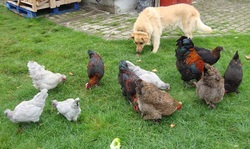
The staple is a special supplementary feed for laying hens and grain bought from a farmer: wheat, barley, oats, sometimes pea leftovers in among it.
In summer they get apples, pears or cucumbers every day, and all kinds of greens from our own and the neighbours' garden: lettuce, carrot, cabbage; broccoli leaves, for instance, are a special treat. Sometimes I boil fish (they will not eat it raw) and add potato and carrot to it. For a feast there are the insides of watermelons and melons.
They have grass across the whole run, so greens are available all the time. In the corner of the run there is a scratching box, with peat for scratching, bathing and cleaning their feathers. I sometimes throw grass mulch in there too, and pick ground elder, dandelions, knotgrass and snails. The children hold earthworm races in the vegetable garden and tip them into the box.
In the evening, when it is time to coax the birds into the shed, I pour a grain and supplementary feed mix into the trough in the proportion and quantity shown on the packet, which runs out by the time they go out in the morning.
In winter there is the grain and supplementary feed mix and every kind of vegetable I can get hold of: carrot, cabbage, apples and all sorts of kitchen scraps (vegetable peelings, outer leaves and so on). Sometimes I even boil eggs as a treat.
From time to time I also give a mineral supplement, maize, sunflower seeds and the like.
Limestone grit and sand of different grades are always available in separate containers. Crushed eggshell I throw into the trough by the handful.
What matters is that the hens get all the nutrients they need but do not get fat. Because hens on poor feed do not lay, and overfed hens do not lay either, they get lazy; and on the wrong diet they will not lay either.
Hens and the lawn.
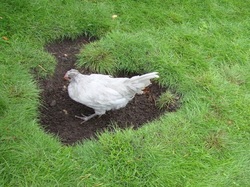
The fact that my hen run is covered in a beautiful lawn astonishes not only other poultry keepers but all my friends and acquaintances who come to admire my birds.
What miracle lawn do I have, or are my hens trained to spare the grass, they ask.
In fact I have a perfectly ordinary lawn that we sowed some years ago and have looked after and cherished ever since.
I would say the secret of my fine lawn is that every day, absolutely every day, I rake up with a large yard shovel and a lawn rake all the little offerings the birds have sown across the grass during the day. People object that hens scratch the grass away, but I see that despite the scratching a healthy, strong lawn stays strong and green. I scatter grain, apples and the like in there for them every day, so diligent scratching is going on all the time.
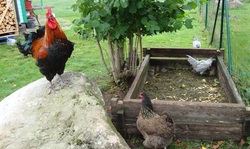
Where it does start to break down is in the most used (most heavily "fertilised") places, where the turf goes weak precisely under the flattened out droppings. If I reckon that I collect two or three good shovelfuls of such fertiliser every day, then in a week that makes a whole garden cart of strong stuff which, trodden into the ground, kills off any vegetation.
A big box of soil, where they can dig about enough and clean their feathers, certainly helps too. The few holes that do get dug over time are repaired the following year, when I move the site of the run.
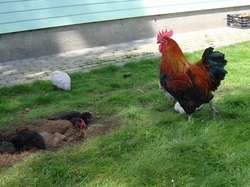
During the hot, dry spell this summer, the hen run was the only place where I watered the lawn. I mow it just as regularly as the rest of the garden.
In the picture above there is only one bird in the box this time and half the flock in the hollow in the lawn, but when I swapped the grass mulch in the box for soil the birds all moved into the box instead.
I will fill the hollow in the lawn with soil in the spring and lay a couple of turves on top.