When does a poultry keeper's spring begin? When you can no longer get out of your head the thought of which exciting new breeds you might add to your flock this year, from whom and where and how to get hatching eggs, how many, whose eggs to put into the incubator yourself and so on. Once again you surf the internet, join every possible forum and Facebook group, read other people's thoughts and experiences, leaf through countless pictures and videos, study breed descriptions, sale notices, prices and the rest.
I am adding a lovely YouTube video here about the development of a chick in the egg (an animation).
A chick develops in the egg for 21 days.
In spring, in March or April, when I get my new incubator, I would like to share the joy of the chicks hatching with other friends as well, especially with children. Watch this video together with the children so that they have some idea of what is going on inside an egg under a hen. If you come to us to see the chicks, or even on the day they hatch, it will all make more sense.
Free range eggs versus supermarket ones: why prefer the first?
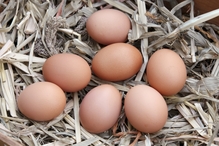
As a poultry keeper this question has always interested me. I myself eat my own hens' eggs with the greatest pleasure, simply because they taste so much better. And the friends I have fed them to say the same. Now, though, I have found an article online, on the website of the web shop OKOMARKET. How far anyone takes it as true is their own affair, but I dare to copy the text here. Do visit the page linked above. There is some genuinely nice reading there for friends of the environment, and sales information too.
Mother Earth News, a magazine of organic gardening and nutrition, tested the eggs of free range hens and of hens raised in a poultry factory and found a great many differences, all of them of course in favour of the free range eggs. The eggs of free range hens were of far higher nutritional value than those of factory hens.
The biggest difference was in vitamin D content: the eggs of free range hens contained 4 to 6 times more vitamin D. It was also established that free range eggs have the following advantages:
*1/3 less cholesterol
*1/4 of the saturated fat
*2/3 more vitamin A
*2 times more omega 3 fatty acids
*3 times more vitamin E
*7 times more beta carotene
These results came from analysing the eggs of 14 different free range hen houses in the USA, where the hens could move about and feed freely in nature. Fresh food and the insects eaten from nature on the hens' menu are the main reason why free range eggs are of significantly higher nutritional value.