About a rare cross, see the picture.
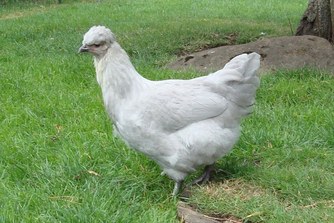
This little bird comes from a repeated crossing of Lavender Araucana and Copper Black Marans. Last year, when the hens were LA and the rooster a CB Marans, all the chicks were black. This year the rooster over the black crosses was a Lavender Araucana again, and the chicks were black, lavender and brown and grey mottled alike.
Sadly it happened that of the four crosses I kept, this one alone turned out to be a pullet. But she is so wonderfully pretty that I never tire of admiring her. Most astonishing of all, her eggs are the palest blue.
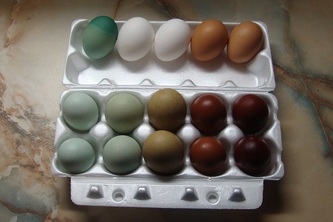
This year's egg box is special for me because, besides the coloured eggs as always, this year there are white and light brown eggs from the hatchery birds as well. And for the first time I have Marans eggs.
Let me list whose eggs can be seen in the box, and then write a little more about my birds.
* Araucana and Marans cross (the mottled green ones, and the 2 pale blue ones at the bottom left)
* Lohmann White (the white ones)
* Lohmann Brown and Moravia Barred (the light brown ones at the top)
* Lavender Araucana (the second pair of light eggs from the left)
* crosses, the black birds, olive green eggs in the middle (Lavender Araucana plus Black Copper Marans)
* crosses, a Brahma crossed again with a Copper Black Marans (dark brown, the second last pair of eggs)
* Black Copper Marans, dark brown, the pair of eggs on the right.
Pictures of the birds can be seen in the summer's bird house post; choose "The bird house" from the list of subjects on the right.
About the hatchery chicks
This year, for the first time, I bought chicks from a hatchery (Sakala): Lohmann Brown, Lohmann White, Moravia Barred and ISA Sussex. Twenty odd chicks in all.
I was very pleased with the chicks, thoroughly healthy and sturdy little birds. What is more, they were extremely peaceable, no stress and no aggression. A week later I dared to put in among them a few of my own chicks hatched in the incubator and some Marans of the same age bought from the village. The chicks added were a full 10 days younger than the others and therefore many times smaller. I watched over the flock of chicks for half a day and satisfied myself that nobody was bullied or harmed in the slightest. They all went to eat and drink together amicably, crept under the lamp to warm up and scratched about in the sawdust. My small worry was that the bigger ones might accidentally trample the little ones, but all was well.
The greatest bonus was that the eggs started dropping as early as week 20, and about a week later all the hatchery birds were laying. Within a couple of weeks most of the eggs had reached size M to L. After a month, four hens started laying eggs of as much as 86 g, about 3 times bigger than the usual pullet's egg. Those especially large eggs even had two yolks. You break four eggs into the pan and get 8 eggs. 🙂
About my other birds
For comparison with the hatchery birds: my existing fine breeds and the crosses too start laying several months later, at first only a couple of eggs a week and, at best, only after a month every day. The eggs also stay smaller for several months longer.
So for those several months when I would otherwise have been without eggs (the old hens in moult), I now got 400 to 500 eggs a month from fewer than twenty birds.
The weakest turned out, once again, to be the Marans. Of five chicks two were bandy legged cockerels that lost the use of their legs at the start of their second month. Extra vitamins did not help, nor a great deal of boiled egg, nor any other pampering. Of the three pullets two also lost the use of their legs, and in the end I got just one layer out of five Marans. The rest of the chicks were entirely healthy and sturdy, with no leg weakness and no health problems.
I also had Araucana chicks with a broody hen, but one night a fox tore the roof off the chick coop and carried off both my Araucana chicks and the mother hen. Such a shame; I was left without young Araucanas. And of the four cross chicks 3 turned out to be cockerels. The fourth, though, is a wonderfully pretty lavender bird, the most beautiful in my flock.
A chick hatched from an olive green egg should under no circumstances lay a pale blue egg, even though the rooster was an Araucana. The pale blue egg is the sole right of a purebred Araucana 🙂 But this bird is a cross, hatched from an olive green egg, and lays delicate pale blue eggs. It is possible that the colour of the egg will change yet. In the egg box above, her eggs are the two small pale blue ones furthest to the left and that single one at the top, which is mottled pale green and blue. I will report back after a while.
If anyone has a view on this, the comment box is waiting. Thank you in advance.