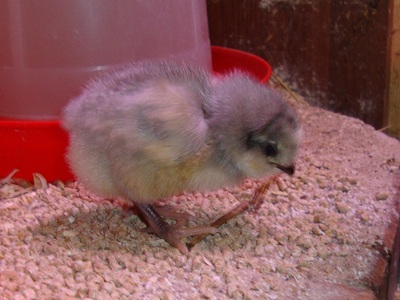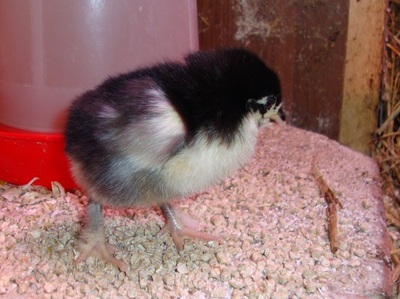
Next into the incubator went the eggs of the purebreds: Copper Black Marans (14) and Lavender Araucana (10).
The 21 days in the incubator passed as they had the time before: steady temperature and humidity, no power cuts and no other surprises.
The hatch rate. Sadly, only 10 chicks hatched from 24 eggs. Of the eggs that did not hatch, 11 were unfertilised, in 2 development had stopped and 1 held a dead chick.
For me the dead chick and such a poor hatch rate were a very sad experience, but more experienced keepers were able to console me: hatching purebreds is like winning the lottery, sometimes you are lucky and sometimes not. Araucanas in particular were said to have an especially poor hatch rate. With crosses the results are as a rule much better. Comparing them now, my crosses hatched at 84%, the purebreds at only 42%. The eggs came from different farms.
The hatching itself was also much slower than with the cross chicks: it started a day and a half later and lasted a day longer, even though there were half as many chicks. The incubation regime was exactly the same.
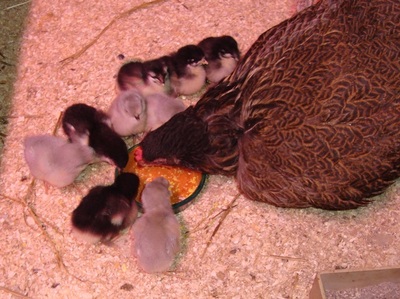
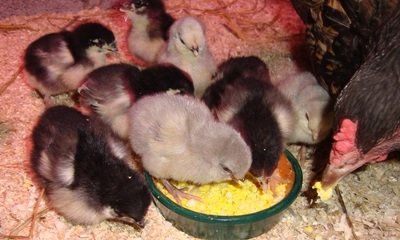
Incubator chicks under a broody hen.
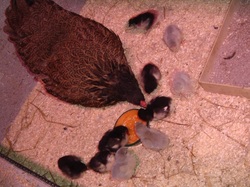
It worked out well that my broody hen went to sit a week after the incubator was switched on. At first I put a pile of plastic eggs under her, but a couple of days before the hatching date I swapped some of them for eggs from the incubator. I was afraid that if I put chicks under her as early as the second week of her sitting she would not accept them. She might, though, if she could hear cheeping in the eggs and at least one chick hatched right there. So once one chick had hatched under her and she had taken it in nicely, I brought the other chicks out from indoors in pairs and put them under her, one lot after another as they hatched indoors and their down dried, that is within a few hours of hatching. She took them all in like a mother. Such a good mum: these chicks are her third brood already.
It is important to put the chicks under at a time when they are all sitting in the warm under the hen and not yet running around the run, so within the first two days. It is also recommended to do it late in the evening, at settling down time. Online I have read a recommendation to swap the eggs (artificial eggs) for chicks one at a time in the evening twilight.
The dead chick mentioned above had grown as big as the egg would hold, so big that it could not have moved to tap its way out. It is possible that this egg was turned the wrong way under the hen. For the last 3 days before hatching the eggs must not be turned any more. For the hen, though, it was only her second week of sitting, and she may well still have been eagerly arranging and rolling them underneath her.
Chicks with a mother hen versus chicks without one. With small chicks it is so lovely when a mother hen bustles about with them. From the practical side it is easy and carefree for me too. The mother hen warms them under her wing herself, and by the second day the chicks are briskly bustling about in a 15 C room. When they get cold they run back under mum's wing to warm up. The hen also teaches the chicks to eat: she calls them over and shows them exactly which grain is edible. She crumbles boiled egg onto the ground in front of the chicks, for instance, and keeps clucking and demonstrating the pecking. She does not eat herself, she only shows them and watches whether they are all managing. Later the mother hen teaches them to scratch, to look for worms, to eat snails and to peck at roots.
My 1.5 month old pullets, for example, still have no idea that earthworms are edible (I sometimes pick them out of the beds and scatter them in the run); they tilt their heads and walk away, and snails do not even come into it. Yet chicks a month younger, who have had their lessons from a mother hen, eat them happily. The same goes for roots and vegetable scraps of every kind.
Chicks with a mother hen can also be taken out to the flock fairly soon, as the mother hen defends her brood very fiercely if anyone dares to harm them. Chicks without a mother I do not yet dare let in with the big ones.
The great advantage of motherless chicks, though, is that they get thoroughly used to their keeper, that is they are far tamer. They come rushing over the moment they see me, they trust my every movement and follow at my heels whenever I am working near them.
The mother hen's chicks, by contrast, keep a strict distance, even though I offer them boiled egg from my hand every day and bring them other interesting things to peck at. Every beakful is still taken only on the mother hen's signal, and at any moment they are ready to hide in the coop. Once the mother hen's chicks grow up, working with them is far more difficult: they will not come when called, they will not let you pick them up or herd them into the run.
I will add here with hindsight that the mother hen pushed this brood away from her at just 1 month old. By day they were outside with the old hens, at night in a separate coop. They did not come to any harm, but outside they got near the food and the treats only once the big hens had eaten their fill. And now I have 4 fine little birds that are visibly more "slender" than the others and terribly timid. They run from everyone and everything, from me included, and they are frightened even when I am pouring food into their own trough under the shed. They hide in the corner and wait until I close the hatch. The other pullets, by contrast, are supremely calm and tame. If need be I can pick them up, move them to another run, or nudge them by hand through the right hatch.
In future I will probably not call on a mother hen's help again.
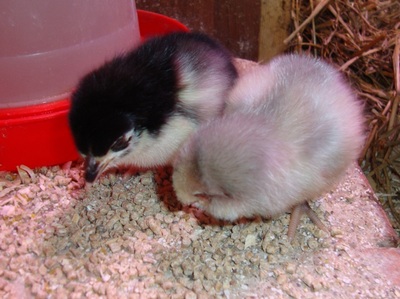
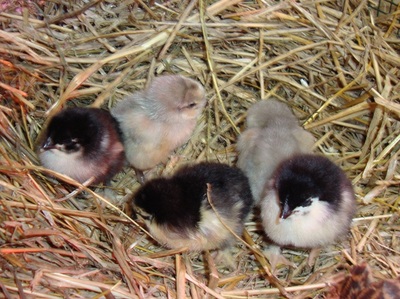
Pictures of the second clutch (Copper Black Marans and Lavender Araucanas) hatching: