Several months have passed since the last bird house post. In the meantime some grim things happened there, and I have been trying to decide whether to keep it all to myself or tell others as well, in the spirit of sharing experience.
Last time I wrote about how peaceable and fine all my birds are. The autumn was endlessly warm; even at the end of November they could be outside every day for as long as their hearts desired. Natural food, grubs, grain, roots and vegetables, and sometimes curd and minced meat, plus supplementary feed, were guaranteed.
Cannibalism.
At the end of November, though, icy winds and rain arrived and there was no more going out. The daily morning ritual of opening the runs stopped. The birds became endlessly nervous, pressing hard against the netting, climbing over one another and wanting to get out at any price. Unfortunately those were also the days when the supplementary feed ran out and I could not drive to get more. I did bring more curd and minced meat, carried them roots and greens and sometimes even gave them boiled egg. But it was no help. The birds became visibly nervous. They no longer ate as usual and were aggressive with one another.
It did not take long before one morning I discovered that my only Marans, grown into a fine, healthy hen, had been pecked to pieces at the back. Exactly as last year and the year before. As soon as she started laying, the others pecked her open. I had to do an emergency slaughter, of course. So I went to check several times a day whether everyone was whole and whether any feathers had been pulled out or skin damaged anywhere. I watched them for hours to see whether and who was starting the trouble, but nothing. I sprayed all the hens at the back with tar spray (against cannibalism and to disinfect wounds). I made the room dimmer.
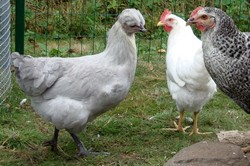
Two mornings later there was the next victim, this time my favourite bird, the grey hen with a tuft on her head. And pecked or eaten so strangely that on her rear there was a bare patch the size of a palm, no feathers and no skin. Only the raw, bloody muscle layer left. There was not a single wound from a beak to be seen. The bird herself did not seem particularly bothered. I put her in the VIP cage and decided to delay the emergency slaughter a little. I smeared that whole large wound with sea buckthorn ointment twice a day. A small bottle of natural remedy that I had in reserve. And that ointment worked a miracle. A large scab close to 1 cm thick formed over the wound and I carried on smearing it carefully. The tiny pot went a wonderfully long way. After a week the scab slowly began to recede from the edges. A week later everything was almost healed; only by the vent there was something like a varicose vein or a small ulcer. Twelve days after it happened the first egg came and she started laying regularly again. The first eggs did hurt a little; they were slightly bloody. I sprayed the ulcer with that tar spray and it helped it heal faster.
That bird now lives in a cage of her own. When I am working in the shed I let her walk about and go among the others. But when I leave I lift her back into the "VIP room". Let her have her own apartment, if her beauty rouses such wicked envy in the others that they simply want to eat her.
Fouling the nests.
An eternal nuisance: every day I put clean hay in the nests. But the result of the morning nest check is always the same: in two of the four nests there is a great heap of droppings at the very bottom with freshly laid eggs in it. What is to be done with young ladies like that, who cannot be bothered to go to the perch to sleep but huddle in the nest at night and then drop a whole night's worth of gut into the bottom of the nest in the morning.
My birds are divided between three runs, and the biggest slob is a white factory hen. Raised here from a chick. She knows perfectly well that you scratch on the ground, sleep on the perch, eat from the trough and go to the nest to lay.
And yet in the evening she moves into the nest to sleep, and before the others get to lay in the morning she drops an enormous heap of droppings into the bottom of the nest.
First I started going out late in the evening with a torch to check whether the hens were on the perch or in the nest. Those in the nest I chased out in the dark. It was dreadfully tiresome, but a week of "night parade" and two fussy young ladies understood perfectly well where the sleeping place is.
Not a week had passed, though, before those two nests were dirty again morning after morning.
Now I started closing that nest during the day. Once the eggs are collected, a piece of plywood goes over the nest. At night in the dark, before going to bed myself, I went through the shed with a torch and opened the nest again. Spring and the time for collecting hatching eggs are at the door. Then I cannot allow dirty eggs. We shall see whether it helps. In winter I did not have the strength to drill them that hard.
They simply will not lay
What is the point of keeping hens that laze about all winter, that is, live off me for nothing.
When I had only those various fine breeds, how I used to worry about what I had done wrong again. Is the proportion of supplementary feed wrong, or is there a vitamin deficiency, or is the room too cool, or perhaps the lighting too weak or too strong, or have the birds simply overeaten and can no longer be bothered to lay.
How much I studied and read, hundreds of pages of material, everything remotely available online. Bought books, tried different and most expensive feeds, weighed the daily food rations ever more precisely, bought the hens foods I would not treat myself to. Studied, checked and adjusted the lighting and the length of the light day, heated the shed with electricity and so on.
But if a hen does not want to lay, she does not lay. You can walk on your hands or feed her gold.
Now, when for the first time most of the flock has been raised from factory chicks, I see how needlessly I have worried all these years. At the moment I have, for instance, 12 factory hens and 6 different crosses. They all have exactly the same food, lighting, warmth and so on.
The factory hens laid all through the winter, 29 to 31 eggs a month each. Two green egg crosses (Marans and Araucana) have laid on average 15 to 20 eggs per bird a month, and since the beginning of February neither has laid a single egg. I also have two dark brown egg crosses (Marans and Brahma), whose yield has likewise been up to 20 eggs a month per bird, and in February one no longer lays at all. Two Araucanas went into moult in September and have not started laying since. Three eggs between the two of them over Christmas and that was that.
I believe nothing more here depends on me. It is probably not possible to pamper birds any better. I have drawn my own conclusions: if no money tree grows in the yard, it is sensible to keep hens that actually lay. A few young ladies of the coloured egg may well be in the flock, so that the egg box is pretty and colourful. But pampering a whole flock of exotic birds or crosses is too expensive a hobby.
Hence this year's direction for hatching eggs and raising chicks.
Plans for hatching eggs and chicks in spring 2015
This year I have reserved myself a Lavender Araucana rooster.
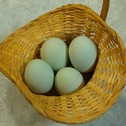
Pale blue egg chicks.
From the white egg factory hens (Lohmann White) will come pale blue egg chicks, who will quite probably lay far more than the Araucanas. I have also struggled so far with the fact that the hatch rate of purebred Araucana eggs is fairly close to zero. The hatch rate of the crossbred hens, though, was close to 100%. So Lohmann White and Lavender Araucana crosses give not only very fine pale blue egg layers but hatching eggs with a good hatch rate as well.
If my Lavender Araucana young ladies do decide to start laying, there will be purebred chicks as well. But I am not counting on that much any more. If it works, good; if not, so be it.
Pale blue eggs are also laid by my lavender beauty who was injured in the winter. I hope to get offspring from her too. Today she is a thoroughly good layer, as crosses are.
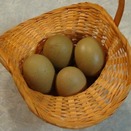
Pale green egg chicks.
From the Lohmann Brown (light brown plumage and light brown egg), ISA Sussex (light brown egg, white plumage) and Moravia Barred (light brown egg, black plumage with white speckles) birds will come pale green egg layers.
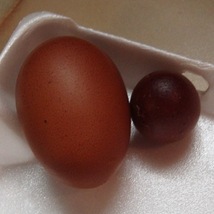
If my Marans and Araucana crosses of several years do after all decide to carry on their line, that is to start laying in spring, there will also be splendid tufted chicks that lay slightly darker green eggs. The picture here shows this year's eggs from those very hens. Crossed with the Araucana rooster again, the offspring's eggs will be a slightly paler green.
When I have brought the rooster home, I will let you know. The rooster comes from Lutsu farm in Parnu county and before that was from Karin's flock.