By the calendar it is spring, although the drifts outside are still deep and more keeps falling. The hens are laying bravely, and worried that they will soon go off on their spring break (they have been laying less and less often), I am planning to put at least one batch of my hens' eggs into the incubator.
For hatching eggs it is recommended to use eggs up to 1 week old, at the very most 3 weeks, kept at a temperature of 10 to 12 degrees.
This time mine were up to 17 days old, kept at 8 to 12 degrees. I also marked the dates on the eggs so I could draw conclusions at hatching. As one more egg fitted than I had counted on, I added an egg that had already spent a night in the fridge.
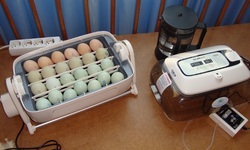
My incubator is a King Suro 20, fully automatic, for 24 eggs.
Since Araucanas lay small eggs, 25 fitted this time: 6 Brahma, 6 Araucana cross and 13 Lavender Araucana eggs
Eggs into the incubator: I stood them on end, pointed end down. After loading the eggs into the incubator it is recommended to let them stand for about a day at room temperature, pointed end down, and only then switch the incubator on. When you switch the incubator on you can also lay the eggs on their side.
The incubator gave me no trouble at all: it held the temperature (37.5 C) and the humidity (45%) by itself and tilted the eggs back and forth on the whole tray (otherwise you would have to turn them yourself). A pump and a water container are connected to the incubator. Comfortable and safe.
Candling the eggs: an experienced eye can tell from the fifth day whether anything is developing in the egg. I have neither a candler nor an experienced eye. I candled the eggs on day 11 in a dark room with a desk lamp and a toilet roll tube. The Brahma eggs (6) showed up nicely: in four there was a clearly distinguishable large dark mass, in two only a small faint patch. Araucana eggs, on the other hand, have a fairly dense and opaque shell. In nearly all of them one brighter spot was still visible, the air cell at one end of the egg. I discarded none of the eggs this time.
A week later I candled the eggs again and discarded 2 Brahma eggs that were exactly as translucent as at the start. I kept all the blue eggs.
Three days before the hatching date, when the eggs must be left in a fixed position, I lifted the incubator off its rocking frame and turned the humidity up (65%). If it is too dry or too wet, the membrane of the egg can stick to the chick's beak and the chick suffocates, or the membrane dries onto the chick.
Getting ready for the chicks.
I am waiting with enormous excitement for my first two dozen chicks. To take the edge off the impatience I got hold of and laid out:
1. Complete feed for chicks (GMO free), ADE AQUOSUM (a water soluble vitamin) and limestone grit, from the Kiti feed shop;
2. Vitamin D, from the pharmacy;
3. Fine sand, from the builders' merchant;
4. A plastic box and a desk lamp for the chicks' first nursery.
5. A small travel box left over from the rabbit, and a desk lamp, which became the so called foster mother.
6. A heat lamp and spare bulbs, from the farmers' store.
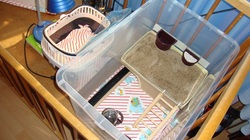
To fit out the chick box I found everything I needed among things we had at home: a drinker and feed cups from old parrot equipment, and a little wooden ladder too. I made a trough from a piece of hose: I cut the hose open along the top with a knife, smoothed the edges with a whetstone and sandpaper and put a wooden strip underneath as a weight.
I fastened the drinker and cups to the wall of the box with masking tape and pieces of drinking straw. For the fastening loops on the drinker I used pieces of straw and florist's wire. From a scrap of netting I made a cover for the opening in the lid. Old bedsheets and sand for the first bedding, so that anything wet is absorbed at once and the chicks can peck sand for their crops (at first they do not know to look for sand in a cup). From a cardboard box I made them a shelter, to give them more to do climbing and creeping about and a little extra room as well.
Into the cups went fine sand in one, limestone grit in the second and complete chick feed in the third. I put feed in the trough as well.
See the pictures in the gallery.
The foster mother I made from a small travel box. That is where I lift the newly hatched chicks to dry off and find their feet before they go in with the others. Before the chicks arrived I kept the lamps on for a good while and checked the temperature directly under the lamp and at the edges of the boxes. Directly under the lamp it should be no hotter than 35 to 37 C. If the chicks are too warm there, they must be able to move away from under the lamp into somewhere cooler.
The temperature in the first week could supposedly be reduced by about 1 C a day. My chicks were happy and content, but the temperature came down by about 3 to 4 C a day until it reached room temperature (20 C).
Too much warmth slows the development of the feathers.