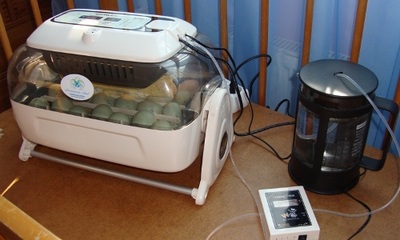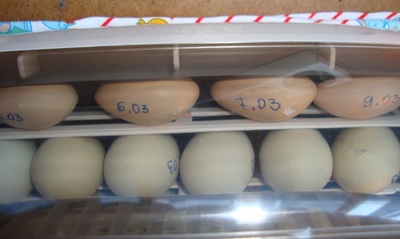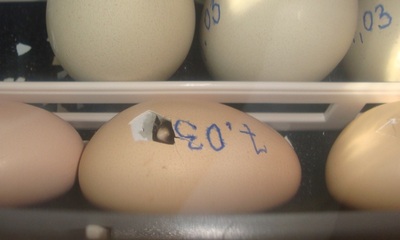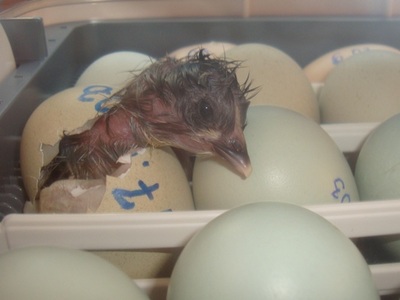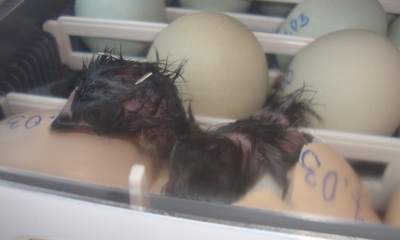
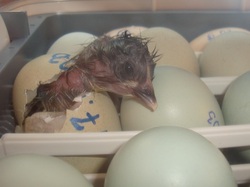
Twenty one days of incubation were up by Sunday midday, and on Saturday morning between 8 and 10 the first small pips appeared in nearly half the eggs. Now and then came a quiet cheeping and scratching. Six or seven hours later, around 3 in the afternoon, 2 chicks decided to race each other out into the wide world.
They started tapping the shell open all the way round at exactly the same moment, quick, quick, racing one another, and at almost the same instant the dome of each shell came away and at the same instant they stretched themselves out of the shell and cheeped their first cries of victory. One of the two fastest was the egg I added from the fridge at the last moment.
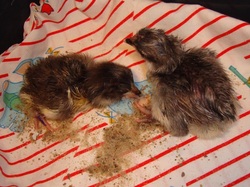
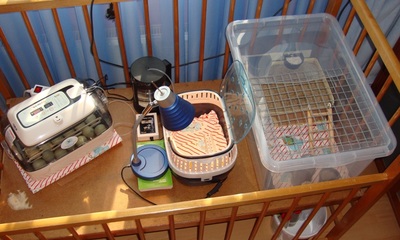
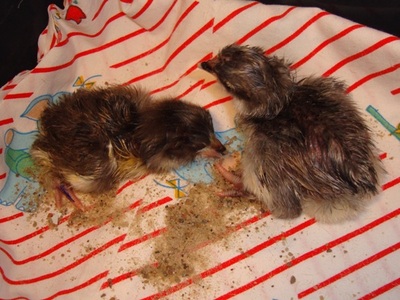
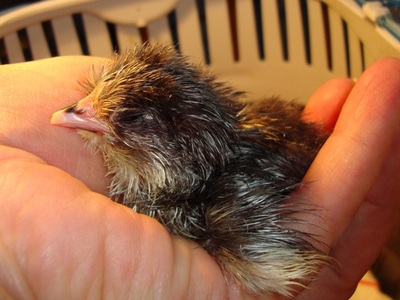
I lifted the newly hatched chicks out of the incubator and into the foster mother to dry; the temperature there was 37 C, much the same as in the incubator.
Into the incubator I sprayed a little warm water through the gap in the lid, because opening the lid drops the humidity in there by twenty odd per cent in a moment and it takes time to come back up by itself.
Once the chicks had dried and their legs would carry them, I gave them a drop of vitamin D from a pipette into the beak and moved them into the big box (33 to 35 C).
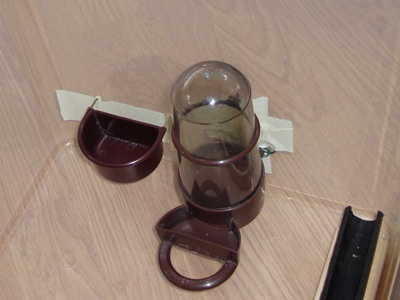
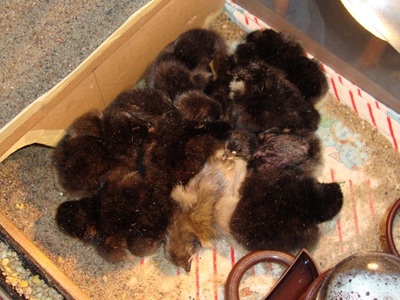
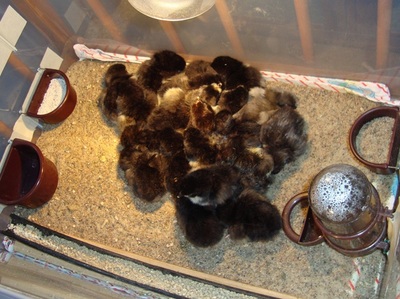
I showed every one of them where the drinker was, dipping the tip of the beak into the water once. They had indeed got thirsty in the foster mother and took a good few beakfuls straight away. Once there were more chicks in the box, each new arrival settled in a little behind the drinker, huddled in the corner, listened to the others cheeping and studied what was going on. The older residents often came over in a flock to inspect the newcomer and "feel" it with their beaks. Minutes later, though, the newcomer would stand up decisively and push straight into the middle of the crowd, where it is warmest.
The hatch rate was surprisingly good this time. Of 25 eggs, 21 sturdy, healthy chicks hatched. Four eggs were unfertilised, 2 of them Brahma, 1 Araucana and 1 from a cross. I am very pleased with the rooster indeed.
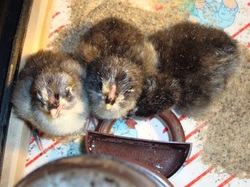
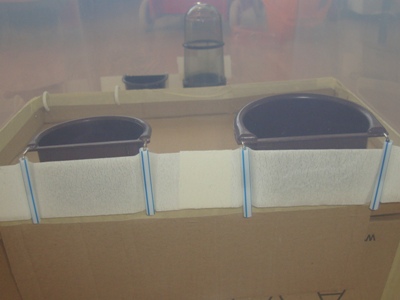
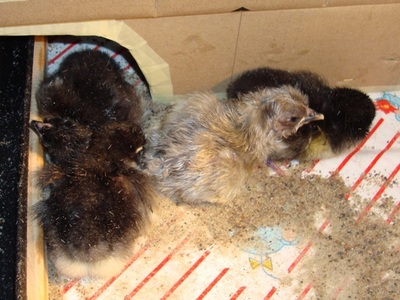
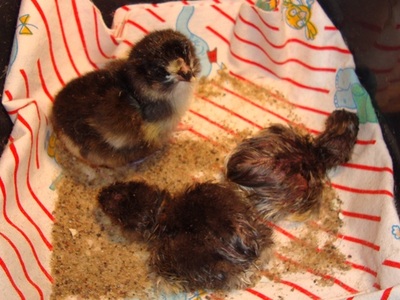
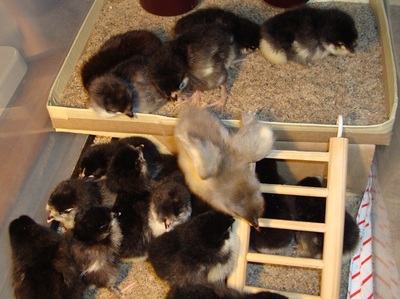
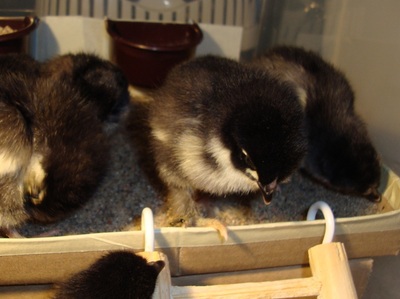
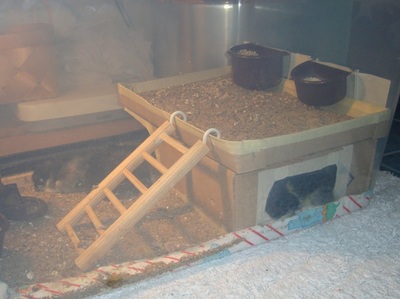
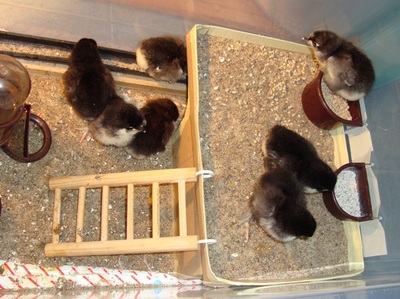
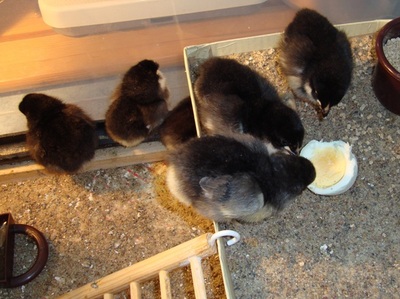
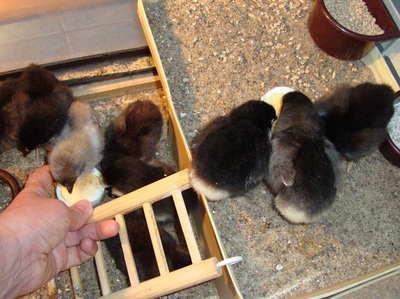
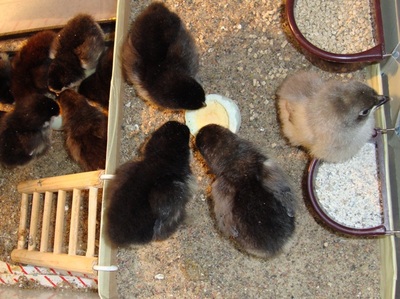
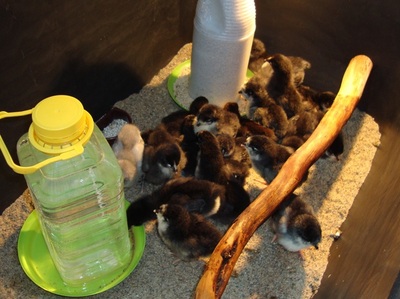
The chicks were happy with the nursery. There was little room, but for the first few days all they did was peck sand, drink water and sleep in a huddle. At the very least, a small box is easier to keep warm with a desk lamp.
When they got cold they crept under the cardboard box to sleep in a heap.
They started eating on the third day. Concentrated feed was available all the time, but a couple of times a day I gave them boiled egg as well.
From the fifth or sixth day, once they had grown 5 or 6 times bigger and wanted to be awake and bustling about more, the box did get too small. This year, though, spring drags on and on; it is already the middle of April and outside it is blowing a blizzard. I looked for a way to keep the chicks in the warm indoors for a few more days, as it is still only 10 C under the shed roof.
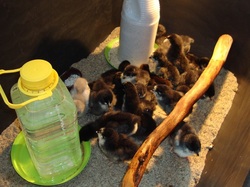
A bigger "room" for the chicks.
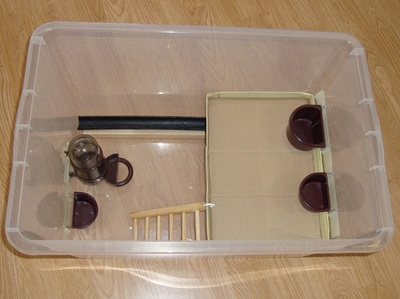
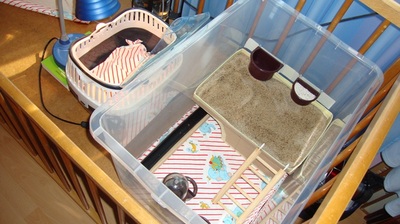
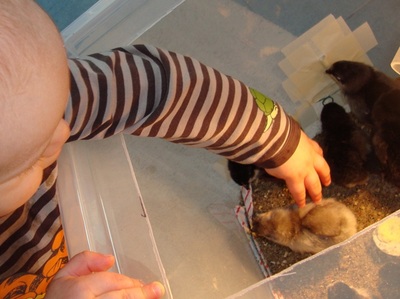
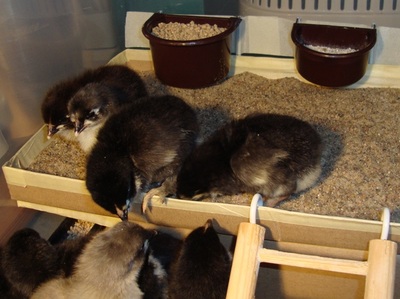
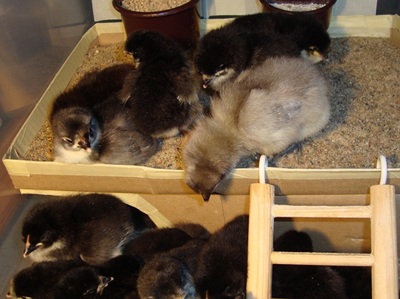
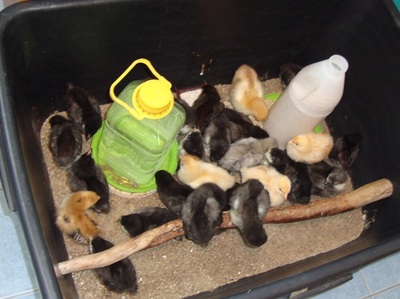
I brought a big mixing tub indoors and set up a new home for them in it.
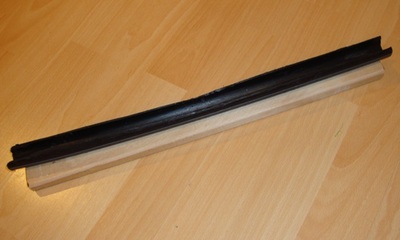
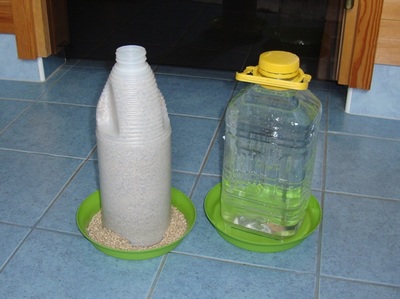
I made a drinker and feeder from flowerpot saucers and plastic bottles, glued together with a glue gun. I put a root in the box as a perch too, because in the previous box they climbed onto everything that could possibly be climbed: the rim of the drinking cup, the feed and sand cups, the edge of the trough.
On the first day only a couple of the boldest managed to jump onto the piece of branch, but a few days later they were already dozing on it in a row. In the third week, when this "chick room" got cramped too, I moved the chicks out to the run under the shed roof, under the heat lamp.
New chicks joining the flock. I bought myself 5 more chicks: 3 Sussex and 2 Buff Brahma. The new chicks were only a couple of days older than mine and settled in with the flock quickly. A little curiosity from the other chicks, but no fighting and no struggle for rank.
Ten days or so later, though, the Brahma chicks started getting bullied, both of them. Until then there had been no squabbling at all, and then at some point both Brahma chicks had been pecked raw under the tail. I put them apart from the others, cleaned them up and sprayed them with a special tar based solution. One chick recovered quickly, the other did not and died on the third day. The chick that recovered I took back to the flock during the day and sat with it. At night I took it away again.
On the first day nobody bothered it, but then the bullying and the hurting started up again. I "punished" the ones who started it, but nothing helped. The Brahma chick was a particularly proud and handsome little bird, a bit bigger than the others, buff plumage in the middle of a black flock. It was neither weak nor submissive; it tried to defend itself, to stand up to the bullies or to find cover. But most of the flock were united against it, and in the end I took the chick back to its former owner. Such a shame, it was a beautiful bird. Perhaps the others were simply jealous of such handsome birds. The Sussex were from another flock too, and buff, yet nobody touched them.
Pictures of the first clutch (the crosses) hatching