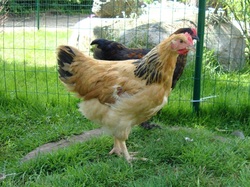
By the end of June, with the first clutch, that is the crosses and the Sussex bought from Lutsu farm, coming up to 3 months old, I can finally tell the cockerels from the pullets clearly.
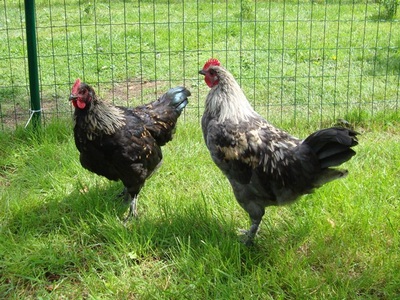
As I mentioned above and as the pictures show, the father was a black copper marans. The mothers were a gold Brahma, a lavender araucana and a grey plumaged cross hen that lays pale blue eggs.
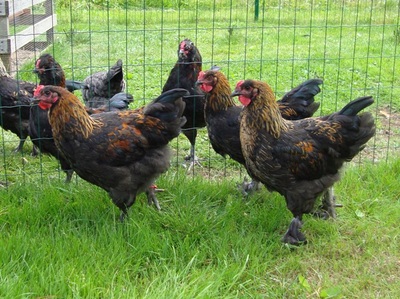
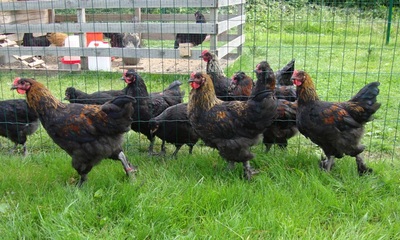
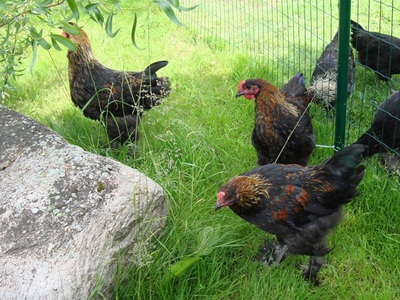
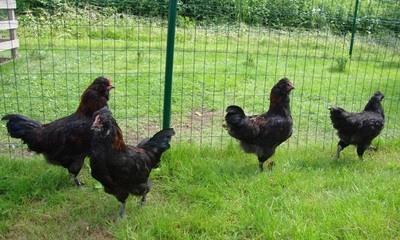
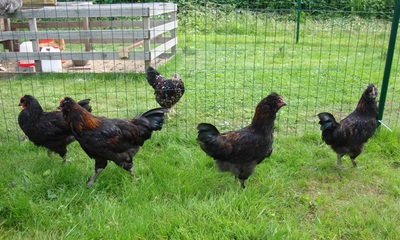
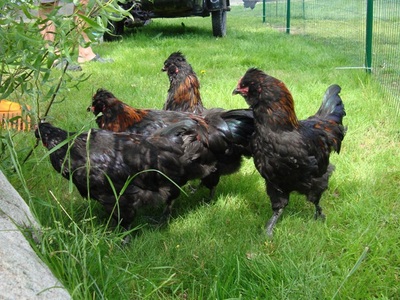
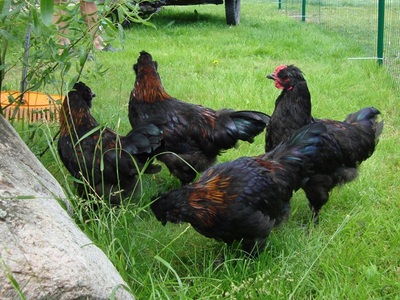
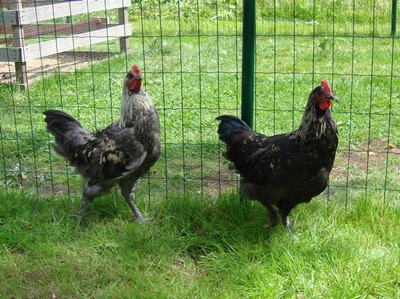
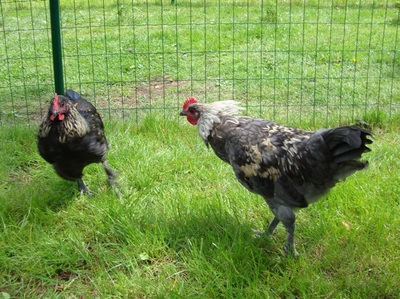
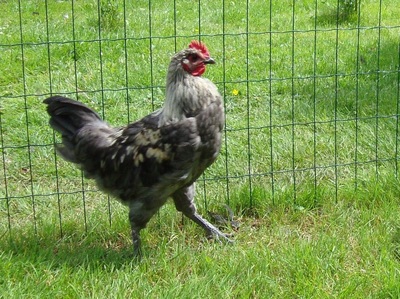
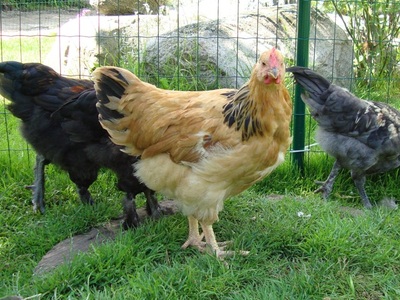
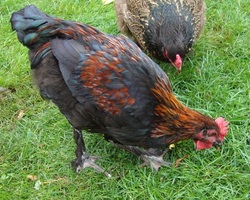
The young Araucana offspring, the pullets, are black all over with a big black "mop" on the head. The Brahma's offspring, a pullet, is black too, but with bronze feathers on the neck like a Marans hen. Only she has a bigger body than the Marans and fairly well feathered legs, as Brahmas do. The grey hen's offspring, a pullet, is dark grey. In the cockerels, though, both the Brahma's and the Araucana's offspring have plenty of bronze in the neck and saddle feathers, the tail feathers are black with a greenish sheen and already noticeably longer than in the pullets. The grey hen's cockerel offspring are mottled grey in every possible shade, like any proper farmyard bird. None of the Marans features stayed with them.
In the flock of 20 young birds the ratio of cockerels to pullets is exactly half and half, that is 10 pullets and 10 cockerels: from the Brahma 1 pullet and 3 cockerels, from the Araucana 6 pullets and 4 cockerels, from the grey hen 1 pullet and 2 cockerels, and from the bought Sussex chicks 2 pullets and 1 cockerel.
In the purebred clutch, the Marans and Lavender Araucanas, things are a little worse. Of the 10 birds only 4 are pullets and the remaining 6 are cockerels. Let us recall that I bought 24 hatching eggs and ended up with just 4 pullets. Sad, is it not...
Pictures of the young (3 month old) cockerels. The cockerels are in front of the netting:
What to do with a flock of cockerels?
This is my third year of keeping birds, and so far we have reduced the flock only once. I do not know what miracle it was that of the first four chicks 3 were pullets and only 1 a cockerel, and that our own chicks hatched last year (3) were all pullets. But now there really is trouble in the flock. The cost of feed and a hen house that has got too small are still a small worry. But when the young males start crowing against each other at 5 every morning, it is quite dreadful. Ten of them. Because the sound these young birds make in the middle of breaking their voices, each trying to outdo the other, is better compared to a rusty garden gate creaking than to a cockerel's crow. Luckily they have not started brawling yet, probably still too young. Or perhaps they are simply polite. In a word, on the fifth morning at 5 o'clock I made up my mind to get this grim job done. I might hold out myself, but in front of the neighbours it is dreadfully embarrassing. We do not live in the woods, after all. This is a built up area. My experience so far runs to cleaning a couple of hens that were going into retirement, and even that together with my husband. This time circumstances meant I had to manage the whole thing entirely alone.
I am writing it down here because before our first soup we too looked up what other people had written online, watched videos on YouTube and talked the subject over with my mother in law. As a former city child, it is not at all easy to go from a ready made boiling fowl to dealing with carcasses yourself.
So: I decided to take 7 cockerels out of the flock of older young birds and keep only the 3 finest specimens.
How to begin...
Before I put out breakfast and let the birds out, I took those 7 birds out from among the others and shut them separately in one coop. With an empty gut the work is cleaner and there is not such an unpleasant smell.
One way to catch a bird is to pour out the feed and then take it by the neck from the edge of the trough and into your lap. But if there are several birds, they are all soon alarmed and you will not catch the next ones. If there are more birds, you can also catch them late in the evening, when the room is dark and the birds are in a row on the perch. You take them into your arms one at a time and carry them off. In the dark they do not struggle. You can take a torch to help and talk quietly to let them know it is the household.
Once the cockerels were caught and separated, I put out food and water for the others and started getting ready.
EQUIPMENT:
* A sharp axe and a block. For the block I used a thick piece of board big enough for the whole bird, with 2 bent nails to settle the cockerel's neck between. For that I laid a wooden dowel along the block. I drove two nails in on either side of the dowel, about 5 to 7 cm apart, and bent them round the dowel. Then the cockerel goes on the board on its side with its head zigzagged between the nails. After that you hold the wings down with one hand and the other is free to do the grim work.
* A bucket with a plastic bag over the rim and a rag in the bottom. Once the head is off, the bird can go in upside down. The blood soaks into the rag. Afterwards you can throw the feathers in as well and tie the bag shut.
* A container for the offal.
* A container for the carcasses. I also had an old bedsheet ready, because the flies arrived at once. With that I could cover the container while I cleaned the other birds. If there are more birds you will also need a separate container (a black cement tub) for the birds not yet plucked.
* A good sharp knife to cut the opening for drawing the innards out.
* A hose and an empty bucket to rinse and cool the carcasses.
* Rubber gloves were especially good helpers for the plucking.
* A big sheet of plastic down on the shed floor.
* A bucket of hot water and more hot water in reserve in case the water needs changing or topping up. The water should supposedly be about 60 degrees. Hot enough to loosen the feathers. Too hot and it takes the skin off. I added a little hot water after every two birds. I have also read Finnish accounts online where people who do not eat the skin use boiling water and clean the carcass with the skin on. They do not pluck at all.
* A big sheet of plastic down on the shed floor.
And then...
I brought the cockerels out of the shed one at a time, silently asked their forgiveness, stroked and calmed them and tried to be gentle and good with them to the last moment. Then hold them by the legs and let them hang head down until they go still. It does not work with all of them, but on the block, neck between the nails, they are as if hypnotised.
Then I did what has to be done with an axe. The birds upside down in the bucket, held until all was quiet, and then lifted one after another into a row in the big tub.
After that into the hot water until the feathers loosened, and then plucking. I had rubber gloves on, and when the feathers are properly loose the job goes quite quickly, handful by handful.
After every two birds I topped up the hot water, as I am still slow at this and the water cooled quickly.
There are all sorts of aids for plucking too. A friend told me that a plucking machine would clean one bird completely in a couple of minutes. She has a plucking machine made at home from an old washing machine. Plucking aids are also made from a cordless drill, with a special rubber fingered head fitted to it.
Once the feathers are off, cut an opening at the back with the knife and take the whole lot of innards out at once with your hand. The gullet usually stayed attached at the neck for me. So I pushed my hand in and pulled the whole lot out in one go, starting from the top. Sometimes it worked, sometimes not. Then over with the hose and one after another into the heap in the bowl of carcasses. Indoors at the sink there was still a good while of picking out feather ends.
This time the whole thing took the entire day, starting with the morning preparations and ending with clearing up and making soup in the evening.
Next time it will certainly go much faster, because choosing the right containers and arranging them sensibly took a fair bit of time in itself. Now and then I simply sat and tried to work out whether I had forgotten anything important that would be too late to go looking for later.
But on the whole it all went rather well: nobody took off or made a run for it, I did not hit my finger with the axe, and even the walls, floor and ceiling of the shed stayed completely clean. In between I allowed myself a few martini cocktails for consolation.
Two of the birds I made into soup that same evening, and it turned out truly good (the others went into the freezer).
But the feeling was such that I did not want to eat cockerel, hen or any other meat for a good while. The others ate and praised it, and by morning 7 litres of soup were gone (some guests happened to turn up at just the right moment).
Best of all, the three finest cockerels that I kept have now found a new home. And besides a small payment I also got several big boxes of truly good chocolate. Pleasant to nibble at while sewing.