Spring has reached my house too.
The snowdrops are in flower and the tulips, daffodils and crocuses have poked their noses out of the soil. And the incubator is humming in the corner. A slightly bigger one than last year.
Experience showed that if you are planning on 15 to 20 hens there is no sense in fussing about with a 24 egg incubator. From one batch I got 20 birds, 10 of them hens. From the second batch, bought purebred eggs, only 10 birds hatched, 4 of them hens.
Since birds of different ages cannot be put together, you end up wrestling with two flocks. Separate runs, coops, troughs, drinkers and so on. Double the work and trouble. And for the whole summer and half the autumn as well, because some breeds start laying at 5 months and others only at 8 or 9 months. Then one falls ill or otherwise loses out to natural selection, and by the time they finally start laying you have some ten pullets and half the run empty, and instead of the 20 eggs a day you planned for, only 7 or 8.
So I sold last year's incubator and bought a 50 egg box instead.
Now the first batch of eggs is in the warm: 52 eggs in the incubator and 12 under a hen who has just gone broody. Half the eggs are from the Lavender Araucanas and the other half from the green egg layers (Araucana, Marans, Araucana), with a few dark brown layers (Sussex, Marans) in among them.
Ten days later, after candling the eggs a second time, it was clear that 20 Lavender Araucana eggs had not started to develop; empty, quite empty. Most of the Marans and Sussex eggs, from which I had hoped for caramel brown egg layers, were the same.
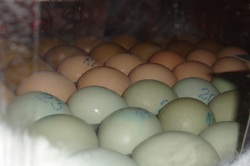
The green eggs did not show through, but on careful inspection a clearly distinguishable air cell was visible at one end, in all of them. From experience so far, I can say they had all started growing nicely. Every one.
Last year I already found with bought hatching eggs that the Araucanas' hatch rate is fairly poor. Several people have said they have given up bothering with Araucanas for that reason. The rooster cannot be blamed, because with the same rooster the crossbred hens' eggs promise the best possible result.
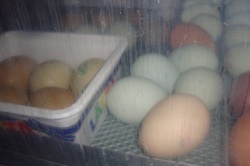
So what now? An enormous incubator and more than half of it left empty. I decided to add new eggs, due to hatch 14 days later than the first ones.
When there were 3 days to go until hatching, I took the dividers out from between the first batch of eggs and lifted them into boxes, so they would stay put there and not push the mess about when they hatched. The others I turned by hand 3 times a day.
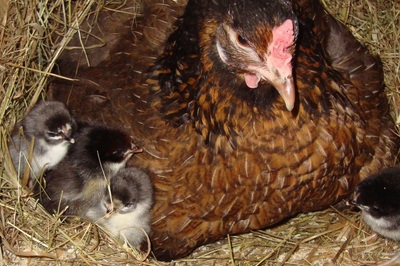
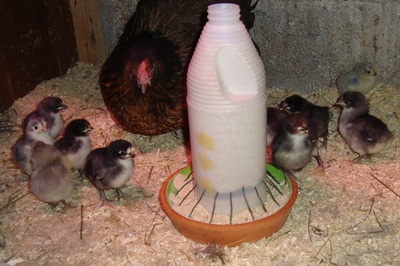
The hatching date came for the eggs put under the broody hen. I had put her in a separate run well in advance, changed the bedding, dusted everything with disinfectant and put out shallow drinkers and feeders.
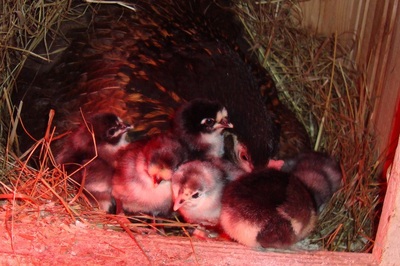
I put the eggs under the hen 2 days early, since the shed is relatively cool (13 to 15 C) and hatching there probably takes a day or two longer than in the machine. There were a lot of eggs too, 12, and being a beginner at brooding she did not know how to arrange them properly under her wing. I helped a little at the start, and a couple of days later she was already making sure herself that everything was nicely hidden and warm.
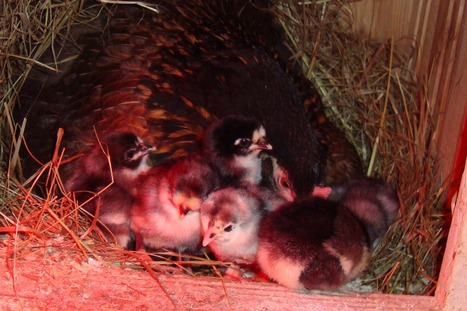
On the right day only 1 chick hatched. A day later, by the following midday, 2 more. All along I was worried that once the first chicks walked out from under the hen she would leave the remaining eggs where they were and go with the chicks to eat and drink. I left the pipped eggs under the hen but took the others indoors. I candled them, and the eggs with chicks in them I put in the incubator.
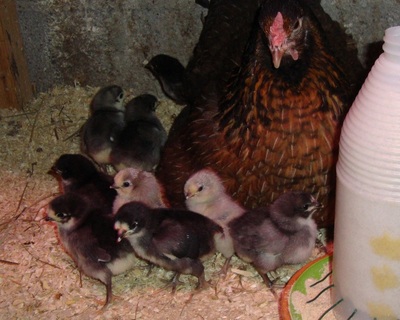
By evening there were 5 chicks under the hen and 1 more in the incubator, which, once it had recovered from the exhaustion of hatching and dried off, I took late in the evening to sleep under the hen's wing with the others. The last chick hatched in the incubator on the third day. I believe that because the eggs were not very well arranged under the hen at first, some started developing at a slightly different moment. In the first days several of them were half out from under her wing. I pushed them further under her, and a couple of days later you could see her carefully arranging the eggs herself so that nothing was left sticking out.
The chicks are all sturdy and active and hatched without any outside help.
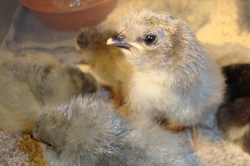
Two days after the chicks hatched under the broody hen, the incubator chicks are due.
But there is not a single pip to be seen nor the faintest cheep to be heard. Did I really count the days wrong? Sunday evening has come and exactly 21 days are up. Silence.
It seems quite unbelievable that 23 eggs, which were candled on day 10 with the chicks' development plainly visible (I threw the empty ones away), should all at once simply have died inside the shell.
But no. On Monday late in the evening, more than a day later, I hear a faint cheeping. And the next morning, oh the joy, life in the incubator has begun to swarm. The room echoes with peeping and cheeping and half the eggs have pips in the shell. And the first chick with lavender plumage is bustling about the box. By evening 8 chicks have hatched, several more eggs are open and the eager cheeping in the incubator goes on.
It raises the suspicion that something was not right with the temperature. The chicks are sturdy, healthy and active. We checked the temperature in the incubator with two mercury thermometers and an electronic infrared thermometer as well. They all showed 37.3 to 37.4 C. According to the instructions it should be 37.7 C. The thermometer inside the box, the one it should have been calibrated against, showed close to 39 C. Make of that what you will.
Most of the chicks that hatched had the rooster's colour, lavender plumage. A few black ones among them too, including one Buff Sussex crossed with the CB Marans rooster, so again the rooster's colour.
Some poultry keepers claim that when you cross two birds of different plumage colours the pullets inherit the rooster's feather colour and the cockerels the hen's. It would be nice to find out afterwards whether 11 of the 14 cross chicks hatched really are pullets 🙂 Rather unbelievable.
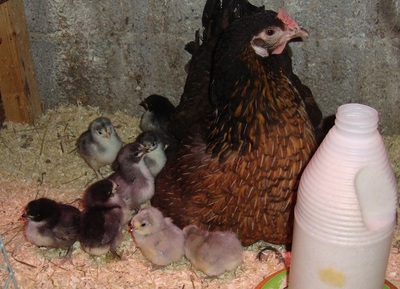
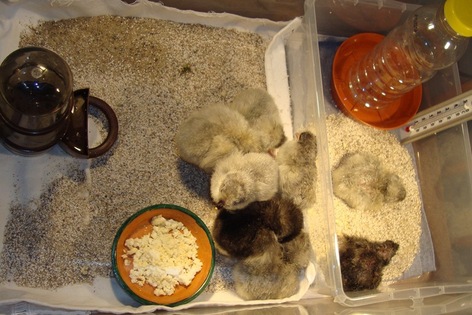
The picture shows that of the eight chicks hatched so far 6 are lavender and 2 black. Wonderful and endlessly busy characters. In the small box on the right I put the ones that were still a little wet separately, as they tend to get pecked more out of curiosity. Two desk lamps over the edge of the box for warmth.
The purebred Lavender Araucanas I marked on the wing feathers with a dark blue marker. Rings of any kind and little wire spirals seemed terribly big and clumsy for these small characters.
Among the chicks are Lavender Araucanas (pale blue egg layers), crosses that lay green eggs (Araucana, Marans, Araucana), and one dark brown egg layer (Sussex, Marans).
More about the incubator, to finish this saga: I will add with hindsight that the incubator in question was sent back. It could neither hold nor restore the temperature or the humidity. The swing was as much as 10 C and up to 30% humidity.
The chicks' development stopped, or they dried out inside the shell. The longer it went on, the worse it got. The loss came to close to 80 eggs and chicks. Meanwhile the hatch rate of the hatching eggs given to others, both Araucanas and green eggs, was 90 to 100%.
The importer argued with the manufacturer (in Italy) for several months, but the manufacturer's attitude was fairly clear: they are confident in the quality of the product and will not agree to replace the device. I took the device in to be checked and was told that the fault is in the program or the chip.
Wisdom after the fact: do not buy yourself a device like this (Brahma 50TU). I ordered myself another King Suro, which I worked with in previous years and was very happy with. It had simply got too small.