Sources:
"Araucana Buying Guide", an article in the July 2009 issue of Practical Poultry
Articles on the website of the British Araucana Club
Articles published in Maaleht
Lutsu farm website
EstFarm website
Estonian Agricultural Advisory Service
Colour genetics
The ancestor of the domestic hen is held to be the red junglefowl (Gallus gallus), domesticated in New Guinea or China more than 5000 years ago.
A hen's laying period lasts about 300 days.
The moult lasts 2 months, during which they do not lay.
Chicken breeds are grouped into egg, dual purpose, meat, fighting and ornamental birds. Bantam versions have been bred from almost every breed, at about 1/3 to 2/5 of the size of the full breed. Breeds can also be grouped by the region they were developed in (North American breeds, South East Asian breeds and so on). There are over 100 breeds of economic value, and a single breed may come in as many as 16 different plumage colours (colour mutations).
A hen's plumage colour is built from four base colours: black, white, brown and gold. Every possible combination of those gives the plumage colours that vary from breed to breed (dozens of them). Unlike in mammals, a hen's plumage colour can also be influenced by carotenoids of plant origin, which accumulate in the feathers and skin and enter the body through plant feed. These pigments can give black feathers a greenish or brownish cast and turn the skin, beak and legs white, yellow, bluish or greenish.
In laying hens a yellow beak and legs are preferable, because that allows laying performance to be judged at a glance: the whiter a hen's beak and legs, the more intensively she lays, since more carotenoid is then being passed out through the yolk. A poorer layer (ww) has pale yellow legs and beak. Selection has made the adult plumage colour a breed characteristic. In many breeds plumage colour depends on sex, with the cockerels the more colourful.
Australorp
Size:
Cocks 3.2 to 4 kg
Hens 2.7 to 3 kg
Egg yield: 180 to 220 eggs a year, averaging 58 to 60 g. The Australorp holds the world record for egg production (364 eggs in a year).
Egg colour: light to dark brown.
Plumage colours: black (standard), also blue and white.
Description:
Australorps have dense, silky, glossy black plumage with a greenish metallic sheen. The breast is broad and strong, the body massive, the head smallish with a small single comb. Legs and beak are dark grey.
They are smaller than the Orpington but carry a lot of meat for their size. Calm, friendly birds. Hardy in the cold. They start laying at 5 months. The brooding instinct is weakly developed.
Breed history:
The Australorp was developed in Australia by selection from meat birds, from the black Orpington. Thanks to how well they acclimatise they spread quickly. In Australia and elsewhere, though, Australorps were used mostly to produce high yielding laying crosses, usually with White Leghorns. Australorps were brought to Estonia from the USA in 1946.
Araucana
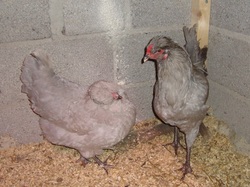
The Araucana is a light breed laying hen.
Size:
Cock: large bird 2.7 to 3.2 kg, bantam 740 to 850 g
Hen: large bird 2.25 to 2.7 kg, bantam 680 to 790 g
Egg yield:
200 to 240, and 250+ a year for the red and black Araucana.
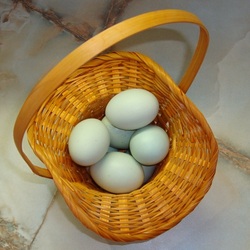
Egg colour: pale blue
A purebred Araucana's egg is pale blue, not green or olive. The pale blue runs evenly through the whole shell, not just over the surface.
Plumage colours: black, white, black breasted red, blue, buff, silver.
The Araucana (pronounced a-roo-kana) takes its name from the province of Arauco in northern Chile.
There are two different standards for the Araucana, the North American and the British. The latter is recognised in New Zealand and Australia too. Both standards cover a large bird and a bantam.
General breed description to the British standard:
The plumage lies close to the body. The down is grey (except in white birds). The wings are large and strong and held against the body. Araucanas are very capable fliers. The tail is a well developed sickle tail at 45 degrees. The eye is bright orange. The small pea comb, preferably in three rows, is bright red and in the hen almost invisible inside the crest. The crest is small and low and must never obstruct the bird's sight. Ear tufts cover the ear canals, and there is a beard. There are no wattles. The legs are of medium length and strong, and in all colours (except cuckoo) black, grey or olive. In the cuckoo they are white with grey speckles. The four toes are well spread.
In the rumpless version the rear is round and the saddle feathers well developed. Tail feathers are entirely absent. The triangular "hen tail" at the body is completely absent too. The ear tufts are strikingly large and cover the ear opening completely. Rumpless birds are slightly smaller than the tailed version. Light green, dark green or olive eggs.
Breed history:
When the Spanish sailed to South America they brought light Mediterranean breeds with them, which soon crossed with the local hens of the Incas. There are several theories about where the blue egg colour came from. Prof. Castolle holds that the blue colour came from a wild South American junglefowl that laid pale blue eggs and was domesticated long before the Spanish arrived. These birds were American pheasants, called Chachalaca. Chachalaca cocks were crossed with domestic hens to produce fighting cocks. Some of those hybrids turned out to be fertile and laid blue eggs.
Serious faults to avoid:
Too flat a breast and an upright carriage. Squirrel tail or wry tail. A crest that is too large or too small. A missing crest, beard or ear tufts. A comb that is not a pea comb but a single comb, flopped or twisted. A hen's comb larger than the smallest possible. Eye colour differing from the standard, or pearl eyes. Yellow legs, legs differing from the standard, feathered legs. White in the down. Uneven or patchy breast colour.
My experience:
My Araucanas are very lively, brisk birds. Noticeably smaller than the other hens, especially the Brahmas, they make up for it in sheer keenness. At the trough they lose out to the big ones, but a treat thrown from the hand they snatch in mid air before the other birds have even worked out to come running. Unlike the other hens, this one always prefers vegetables to concentrated feed. My Araucana today lays a fairly steady 21 to 23 eggs a month.
Thoroughly lovely, cheerful little birds.
I should add that their pale blue eggs make them quite sought after among hobby keepers, but getting hold of chicks is next to impossible. There are probably only a handful of keepers of this breed in Estonia, and the hatch rate is said to be rather low. The last time I could not get chicks, I bought hatching eggs. I managed to get only 10 eggs, of which just 5 birds hatched, and of those only 2 were hens.
Brahma
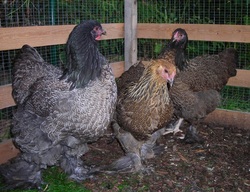
The Brahma is a meat bird.
Size:
Cocks 4.5 to 5.5 kg
Hens 3.5 to 4.5 kg
Egg yield:
Up to 120 to 150 eggs a year.
Egg weight about 55 to 65 g.
Egg colour: cream or brown.
Plumage colours: light, dark, gold, buff.
Description:
The Brahma was developed from the Cochin and Malay. It too belongs among the heavy breeds. A three row pea comb (rose comb) and feathered legs. Brahmas are much used in breeding work for meat birds. Their meat qualities are a little better than the Cochin's, and the egg yield just as good.
The chicks develop slowly and the pullets begin laying at 8 or 9 months. The hens are very good brooders and rearers of chicks.
By plumage colour a distinction is mainly drawn between light and dark Brahmas.
The light ones have silver white plumage. The neck feathers are dark with a white edge, the tail feathers black with a greenish sheen, the large sickle feathers often edged in white.
In dark Brahmas the base colour of the plumage is black, while the head, back, shoulders and wing coverts are silver white. Birds of this breed, like the Cochin, are decorative in appearance.
My experience: Brahmas are very peaceable, dignified birds. That is why I chose Brahmas as my first hens.
In our climate their great advantage over other breeds is their hardiness in the cold: they have very fluffy, thick plumage and feathered legs. Since a hen's legs are particularly vulnerable to cold (which is why they do not sleep on the ground but on a perch), feathered legs are a real advantage in a cold climate. That is also why they lay so well through the winter. The Brahma's average egg yield is low because of the time each season goes on brooding and rearing chicks. Some of them are especially keen brooders. More than one of my pullets went broody after laying their first 10 eggs, laid a few more and then spent another month just sitting. In the end I gave this breed up in favour of smaller ones, because my space for keeping hens over winter is small as it is, and when the nests are occupied one after another by birds that are not laying, it eventually gets rather tiresome.
Brahma eggs, though, are very tasty, somehow of a quite different composition from other hens' eggs. And in all my Brahmas the yolk made up a visibly larger share of the egg than in other hens.
On the colour of Brahmas I would add that several official breed descriptions note that "a distinction is mainly drawn between light and dark Brahmas". To me that is puzzling, because besides the white (so called light) Brahmas I have seen a great many colours online and at other keepers' places, among them buff and gold Brahmas, which I have had myself.
Marans
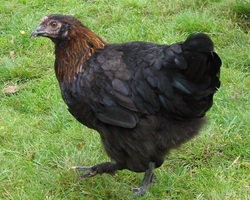
The Marans is a dual purpose bird.
Size:
Cock 3.5 to 4 kg
Hen 2.6 to 3.2 kg
Egg yield:
200 to 250 eggs a year.
Eggs are size L, that is 70 to 80 g, and 65 g from a pullet.
Egg colour: chocolate brown. The Marans is the breed that lays the darkest glossy brown eggs in the world.
Plumage colours: black copper [APA], blue copper, splash, wheaten, cuckoo and others.
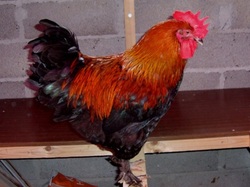
Description and origin:
The Marans is a French breed, named after the town of Marans near La Rochelle in France.
The best known colour variants are copper black, copper blue, splash and wheaten.
There is a characteristic stripe of feathering down the outside of the legs.
My experience:
So far I have had a Marans cock for a couple of years and crossed all my hens with him. The dark brown egg gene from the cock added a darker tone to the eggs of every crossbred hen: pale blue became dark green and dark beige, and the chicks of cream layers became layers of milk chocolate coloured eggs.
This is my first year with Marans hens. Their hatch rate was very poor too. Of 14 eggs 5 chicks hatched, 2 of them hens. One I simply lost, and now (winter 2013/14) I have just 1 Copper Black Marans beauty.
Sussex
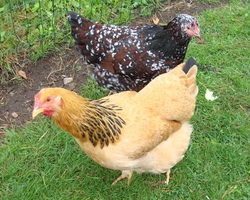
The Sussex is a dual purpose bird.
Size:
Cock 3.8 kg
Hen 2.8 kg
Egg yield: 170 to 200 eggs a year. Average egg weight 57 to 60 g.
Egg colour: cream to brown.
Plumage colours: red, light, speckled, silver, golden, brown, white, lavender, buff and others.
Breed history: The Sussex is one of the oldest English breeds, developed in the first half of the 19th century in the county of Sussex, originally for meat. Before long a variant was obtained that belongs among the dual purpose breeds. It was developed on the basis of the Brahma, Cochin, Dorking and Old English Game.
Breed description: They belong among the heavy breeds. Single comb, light legs. Very hardy birds in the cold. Another peculiarity of the Sussex is that when you cross a hen and a cock of different colours, the pullets take the cock's colour and the other way round. That makes it possible to tell pullets from cockerels right after hatching.
My experience:
The Sussex has been a good discovery for me: they are hardy in the cold, they started laying as early as week 21 (in their 5th month), and above all they do not go broody. They simply lay their lovely cream eggs.