A new clutch to hatch.
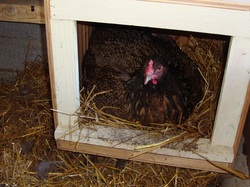
When Pruun started laying in June, her break from laying, brooding time included, had lasted 100 days. In August, though, she took to sitting on the nest again and stopped laying. So I thought, fine, there is half a summer left, I will put her to the test with some eggs too.
But Pruun (in the lower picture) would take neither the new nest nor the eggs, and went off to sleep on the perch. I took her back to the others, where she happily settled down to brood an empty nest. The little Lavender Araucana decided to keep her company at it. Or perhaps brooding is catching.
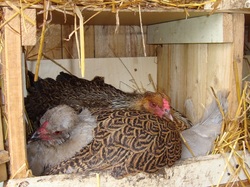
Onto the nest with the eggs I brought Must instead (picture above), who already had 2 months of brooding behind her (see the previous piece). She settled onto the nest at once, tucked the eggs neatly underneath her and did not leave for several days, and after that only once a day for a moment to eat and drink. I am waiting excitedly for the new chicks.
In the picture on the right is Pruun, who would not accept the hatching eggs but is perfectly happy to brood an empty nest. The little Araucana crept in to snuggle up to her. Broody hens are, incidentally, quite happy to let others lay in the same nest.
Hall and her chick back with the flock.
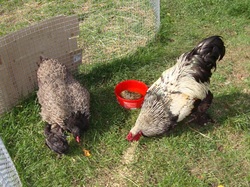
I took Hall and her chick back to the flock, as it is safer together with the rooster. The neighbour's cat looked far too suspicious on the other side of the netting.
Bringing the chick into the flock seems to have been a good idea. New hens are not received nearly as graciously. They get pecked about by the others for quite a while. As a precaution, the mother hen worked the other hens over first, purely for looking in the chick's direction, and after that there was peace in the house.
Today I no longer have Hall or her wonderfully pretty black chick. I sold off one broody hen, and it so happened that the chick went with her.