Lately all sorts of social and antisocial experiments have come into fashion. I thought I would carry out a small experiment too. On myself. Namely, to step out of the role of business owner for a few days and go back to work at the clothing factory where I worked decades ago.
The clothing factory where I worked after I had worked for 10 years as a nursery teacher, and before I worked at a market research firm, before I was head of the Audentes Children's School, before I worked at the parish government as a culture and sport specialist. Before I took yet another degree or founded my tiny sewing business.
These days, working a great deal with patchwork, I go from time to time to Maidi at the clothing company to fetch production offcuts. A box into the boot, and at home I sort through them to see whether and what could be sewn from these scraps. On this visit the talk turned to the fact that Christmas and the holidays are at the door but several people are off sick at once. And plenty of work with deadlines, as always, urgent. 🙂 Would I not like to come and help for a couple of days, to sit behind a machine?
My No-me told me at once: you fool. You are going nowhere. You were supposed to go on holiday from next week. The last Christmas fair finally over, the orders filled or planned into the new year and the second half of December cleared for yourself. I wanted at last to sew something for myself: new curtains, a Christmas tablecloth, a patchwork rug. A few dresses and sweaters besides. And some presents still to make.
My Yes-me whined at the same time: go on, do go. Think how splendid and nostalgic it would be to do something you did several decades ago.
This time Yes-me won by a landslide.
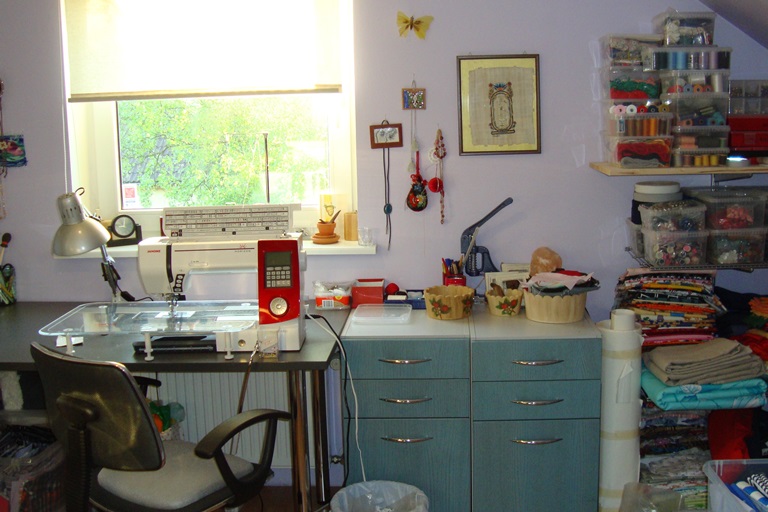
My ordinary day as a business owner starts without an alarm clock, with coffee with hot cream and honey at the computer. I read the day's news, draw up invoices, answer letters, make quotations, surf social media. Then I feed my fish, send the grandchildren to nursery with kisses and hugs and the usual lovely chatter. Then I see to the hens: clean bedding and nest boxes, food and water, collect the eggs. A few quick tidy ups indoors once the family has scattered. At 11 I sit down behind the machine and sew for as long as I have the strength or the inspiration, usually with short breaks until late in the evening. In summer the daily schedule also holds garden work, and in a normal winter clearing snow. In the evening, in front of the TV, hand sewing, drawing and colouring designs, keeping up with craft news, playing with the grandchildren and reading them books. A pleasant and peaceful, absolutely stress free life.
My first working day as a factory machinist began with a dreadful jangling at 6.45 in the morning.
The hurried scramble included seeing to the hens, 2 sandwiches (I do not normally eat at all that early) and coffee gulped down at speed.
I got into the car at 7.20 and tore off. I hoped 40 minutes was enough time to get there on time.
To my surprise the road was completely empty as far as the horizon. Not a single car ahead or behind. A couple of villages later, cars started turning onto the road from both sides, more and more, until finally there was a solid column of red lights in front of me. The queue to get into the city concertinaed 2 km before the Haabersti roundabout. There I ticked over for some 20 minutes and was finally 10 minutes late, that is I covered 25 km in 50 minutes.
I threw my coat into the car, grabbed my bag and rushed in. I put on a face that said I had been there for ages and was looking for the work supervisor.

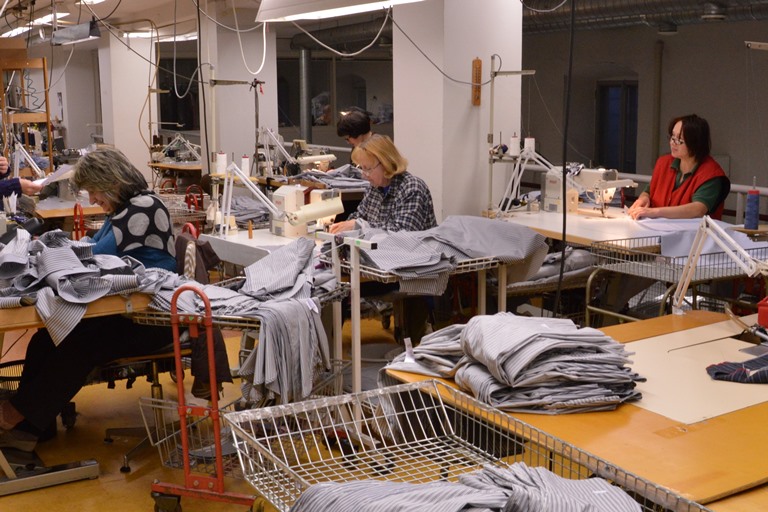
The first working day was thoroughly enjoyable. I was terribly afraid that within a couple of hours I would get nervous, start banging my head on the table, rush out of the door for fresh air or otherwise lose my mind... When did I last sew against the clock...? Long ago, far too long ago. But nothing dreadful happened. It was quite splendid to sit down at a machine, take a pile of pieces and start quietly working away. The good old sleeve plackets, pockets, cuffs, yokes and the rest in among them. I was given especially small batches, 3 to 5 items. Different fabrics, colours, sizes. Just watch that you get it the right way round, the right colour thread above and below, neat seams, surplus marking stickers picked off.
The work supervisor was the same as back then, "old" good Helve. There were other former colleagues too. I sometimes wonder how people can be bothered, or manage, to work in one and the same place so long or even for a whole lifetime. I myself have usually changed not only my job but my occupation every 3 years. Always something new and different. Only at Audentes and at the parish government did I work as long as 8 years.
In a word, the day passed quite nicely: every little while I was hovering behind Helve to ask what I do now, how I do it, what the placket of this model should be like, which colour thread below and above, how wide the quilting on the next piece should be and so on. By the end of the working day I did not even feel tired. Only hunger, because I had not thought to bring either lunch or my own cup. When you have spent the last 16 years working in large offices with a hot drinks machine in the corner and seven different lunch places within a 100 m radius, you are simply naive enough to expect full service.
My second working day as a factory machinist began with an idiotic jangling at 6.30 in the morning.
I had done the usual cleaning of the hen shed the evening before; I only put the food out and told them to behave themselves. I made coffee in a thermal mug to take in the car. I did not want to eat and had no time; I threw a couple of slices of bread into my handbag.
I still only got into the car at 7.15 and tore off. The road was empty as before; in the distance the tail lights of a couple of cars showed ahead. After a while cars started joining from both sides again until a solid column of red lights had gathered. The queue to get into the city concertinaed this time too exactly 2 km before the Haabersti roundabout. There I ticked over once again, sipped hot coffee, listened to music and waited to be let into the city. And I was 10 minutes late again, that is I covered 25 km in 55 minutes.
I threw my coat into the car, grabbed my bag and rushed in, straight to the machine.
Again I did not take a lunch break, because I nibbled those 2 slices of bread I had brought during the rest break and drank water with them. I did think of driving somewhere for lunch, but could not be bothered and had no great appetite.
The work went along normally; I felt no tiredness at all. The ventilation was quite all right too, which I had worried about a little beforehand. My sewing pace was of course still slow, and concentrating on speed cost me every time: bits of thread everywhere 😛 An industrial machine is very pleasant and fast, but to sew to 1 mm accuracy you need a little longer to get used to it.
But I like precision and correctness in sewing, that is high quality. I can never bring myself to buy cheap fast fashion products, which in my eyes are complete rubbish: what quality can you speak of when the edges of the fabric are simply cut, with no finishing, already stretched out of shape or fraying when new. Threads dangling at the ends of the seams or the seams left unfinished. There is no point washing it at all, just throw it away. With goods ordered from a web shop, for instance, the materials look quite all right in the picture, but when you receive the product it turns out the fabric is an ugly faded tone and, or, so thin it is actually see through.
My respect to everyone who still values quality today and knows how to demand and follow it in their production.
My third working day as a factory machinist began with a hateful jangling at 6.00 in the morning.
Half an hour more time than I could have managed to wake up on the first morning.
The hens seen to, I packed myself a lunch (at last). I also took herbal teas for myself and my colleagues to enjoy during the breaks: cowslip, peppermint, lemon balm. I made coffee in a thermal mug and served the sandwiches on a saucer in the car, on the passenger seat.
I got into the car at 7.10 and tore off. The road was overflowing with cars. Rows of lights both ahead and behind, all heading for the city. It brought to mind the story in Spring, where they said that the men from the furthest corner always arrive first...
The queue to get into the city concertinaed again exactly 2 km before the Haabersti roundabout, but it moved very quickly, because from the side roads, where a dense stream of cars had forced its way onto the main road on previous mornings, there was not a single car at that moment. Not from either side.
So I enjoyed my coffee and sandwiches while driving. No waiting about. I got to work nearly half an hour early, that is I covered 25 km in 25 minutes. A record. It is probably not possible to be faster.
I found the cloakroom and was shown a free locker where I could hang my coat.
Since there was a good while to go before the working day started, I wandered about the building a bit and looked at what machines there are and what the others do. It seemed quite exciting, and I had the idea of making a photo report on the subject "How an EWALD dress shirt is made", that company's model.
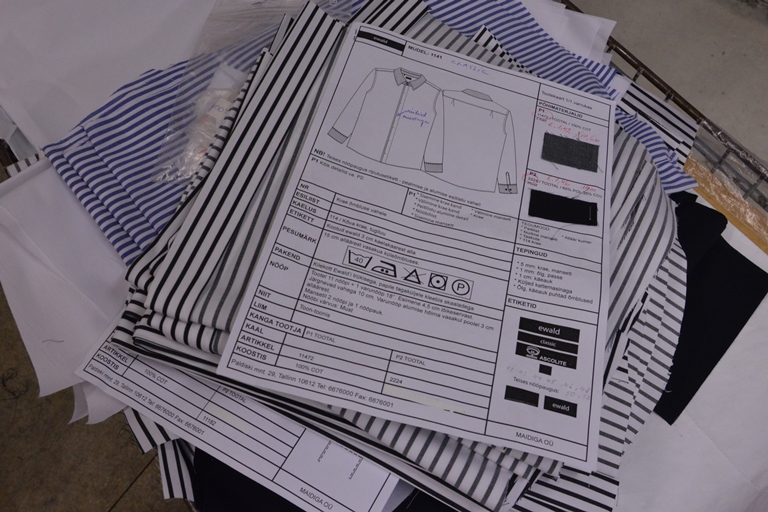
At the sewing I already felt a certain routine. I no longer had to run to Helve over every small thing; I could read from the work sheet myself what to do and how. I tried to pick up the pace, though not very successfully. The bits of thread kept a very sharp watch from the corner of the table and pounced the moment my foot faltered on the pedal.
I already felt a certain tiredness and longed to get back to my quilts. In my head I was planning new patterns and seeing in my mind's eye the fabrics that arrived the previous evening, with roses, with bullfinches, with owls, still unwrapped. At the lunch break I enjoyed hot food and chatted with my colleagues.
After lunch I was brought a pack of pieces for tiny little shirts, sizes from 120 cm, that is for real little ones. The shirts were combined from black and black and white striped fabrics. WONDERFUL. Sewing them was a great joy. If the large shirts were EWALD, then these small ones were EWALD Junior and Little Sir Ewald. I came to like these shirts so much that afterwards I went down to the factory shop and bought Mathias exactly that little dress shirt I had been sewing that same day. So pretty and so dignified 🙂
For Markus I found a splendid shirt with buttons only at the top. He has such a porridge tummy that the buttons will not stay done up. 🙂
Today that unusual working week is behind me. It was a very enjoyable experience. I do not regret a moment of it. 🙂
After two years of working away alone and struggling with the duties of a new business owner, it was pleasant for a change to work in a team. Plus the certain knowledge that you are not responsible for anything more than your own particular part of the work. Everything else has been planned, cut out and assembled by others; the sewing pieces, labels, threads, buttons and the rest, right down to the packaging, are waiting in a stack. Most important of all, there is no need to worry about sales, invoices and other paperwork. 🙂
And very lovely people besides, attentive and caring, offering help with every little thing.
Many thanks to you all.
Next I will make a photo report on how an EWALD Junior dress shirt is made and add plenty of pictures, for which I made a special visit to the sewing workshop one fine day and took a tour with the production manager. There will be a surprise picture of little Ewald's new model too. I will take a few days to take some pictures with the little men, with the shirts I bought them for Christmas as well.